Showing posts with label China. Show all posts

Sunday, September 16, 2012

Reflections on China

The remainder of my China trip was a whirlwind of one city to another, via trains and buses, with a mission in each place to get a new set of maps, go charging off after the next place, get terribly lost and formulate a new plan as I went along, then recover in cafes. I loved it. Instead of going through them one by one, I’ll just hit some highlights of each place I went after Beijing – reading through them quickly will probably give you a better sense of just how fast the time went by to me.

Shanghai

My time in Shanghai was greatly enhanced by having a lovely host, Megan, who put me up after knowing me for about six hours total. We met in April at a concert in Seoul, for which she flew in from Shanghai to see with Katie, our mutual friend who had also invited me. I told Megan that I was planning to travel to Shanghai this fall, and she graciously invited me to stay with her whenever I made it down there. I was so glad I took her up on it – to have home comforts like eating popcorn while watching TV on a cozy sofa is even better when you’re on the road, and Shanghai couldn’t have come at a better time – I was worn out from Xian and Beijing. 

The French Concession
After Megan finished work she took me up to her fantastic apartment, right in the French Concession, and then after I showered and dumped my stuff, we went out for a delicious Schezuan dinner and caught up. She has lived in Shanghai for nearly four years now, and had some fantastic insight into living in China as an expat. After a luxurious sleep in her guest room, I got up the next day and hit the streets for a full day of walking around, seeing the best of Shanghai while Megan went to work.
Shanghai = architecture. From the European style houses in the French Concession to the weird, moderny art-y new buildings, to the Art-Deco 1920s buildings of the Bund, to (not done yet) the futuristic skyscrapers and weird looking rocket ship thing of Pudang (below left), and even to traditional Chinese architecture…Shanghai has it all. So many buildings, so much foreign influence, so much fun to see. I spent the whole day walking across the city, and decided that my favorite part was the Bund (below right). Read more about it here. 
                                                   
Lucky for me, the Bund was even more beautiful at night that during the day. Megan took me to a rooftop bar overlooking the Pudang skyline, while viewing the Bund from the top. It couldn’t have been a more perfect last evening in Shanghai, and I decided it was my favorite city in China thus far. 


 Guilin

Guilin was a last minute change in my itinerary. I was originally planing to go to Nanjing, but after three big cities in a row, soon to be a fourth, I decided against it, and instead made my way south to Guangzhou (where my flight was from to get me to Thailand) via Guilin. Gulin and its surrounding area’s claim to fame is its karst topography, the little green mountains that kind of look like giant thumbs sticking up from the ground.You can see just a hit of one of them in the background of the photo. If you’ve ever seen the recent movie The Painted Veil, starring Naomi Watts; you've seen some of Guilin.


I knew I only had limited time, and I hadn’t done any research prior to leaving, so my plan was just to enjoy what scenery was close by and relax. Luckily, I found a hostel close to the river, the same river I remember reading about in my mom’s journal, so I ventured out there for a lovely evening sunset walk. There isn’t much karst topography that you can see without taking a trip outside of Guilin, so I didn’t get the beautiful images that you see in postcards (see right, from Google Images.) However, just being out in the country, with quiet streets and small buildings, was enough for me. I had spent some time gazing out at the Chinese countryside from the train window that morning (pictured below), and now I finally felt as though I was seeing more of ‘real China’ instead of just big cities. The sunset and night market were a fun way to end the evening and my time in the countryside. 


Guangzhou

I spent approximately 20 hours in Guangzhou, formerly known as Canton, and most of it was spent wandering around in a foggy, sleep deprived haze, as my night bus came in 4 hours earlier than I expected it to. It turned out when the ticket lady said “eight” when I asked what time I would arrive Tuesday morning…she meant I would arrive after eight hours instead of at eight in the morning. I had left Guilin at 8:30 the previous night. You do the math.

Nevertheless, I had a fully day to occupy myself until I flew to Bangkok on a redeye that night. My first stop? Dim sum for breakfast. I joined a cute little crowd of old people (see them all lining up at the entrance, ready for the 7 am door opening?) who apparently were regulars, and sat down with their newspapers, while having their tea poured and prepared for them. I had no idea how to order or what to do, so I just watched for a little while, then I figured it out. Here's how you do it: traditionally I think they roll it around in carts and you just pick these little basket/plate things that you want to eat. This restaurant's style was more buffet-type, but you have to wait for them to bring out a fresh batch of something, then swarm. Yes, swarm. Another reason I patiently waited and observed instead of fought old ladies for some steamed buns - no one wants to see that fight since they would probably win. But, I was successful in the end by waiting it out. They mark your little paper you carry around with you so that they know what you've taken, then you go back and enjoy, pay later. Dim sum and soup for breakfast – yum.

After dim sum I took a walk around and ended up on Saimen Island, which is an ‘island’ approximately 2 meters from the mainland that you ‘cross over to’ on a footbridge. I discovered that it used to be the British and American concession during Canton’s heydays, which made for cute streets, a nice little park, pretty buildings, and, always my godsend, a Starbucks.

 Normally I’d love to include a top ten list about my travels in China, but as time is pressing for me to board my plane to Bangkok, I decided I’d hit on the top five cultural elements of China that had the greatest impact on me. You read about what I did and saw, now here’s more on how I felt during my two week trip:

1. The people. Chinese people are sassy. They’re not afraid to let you have it, to be rude to you, or to cheat you blind. By ‘you’ I refer to any touristy-looking-foreigner they come into contact with - not hard to find in any given city in China. But please don’t get me wrong – though there were a few encounters with not-so-helpful people, my overall impression was that Chinese people are friendly, kind, and helpful. I always got to where I needed to go or received whatever help I needed when I asked. 

My first encounter with a Chinese person was on the plane, when I sat next to this cute little old lady who was fascinated with my illegible scribble that I was writing in my journal. She didn’t hide her curiousity, nor was she bothered by the fact that I didn’t speak a lick of Chinese. I took out my iPod to show her Google Earth’s map and demonstrate that I was from America, but I was a teacher in Korea. I don’t think comprehension was registered, but she had lots of fun spinning the little digital globe with a swipe of her finger. She showed her enjoyment by continuously prodding me for the remainder of the flight, just to smile at me when I looked up, and motioning for me to write my name on the barf bag. Chinese people are great. They get an A. 
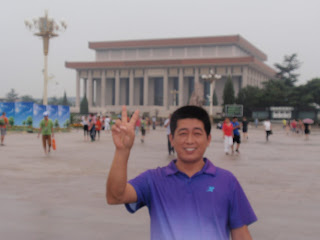
He decided to photobomb and enhance my picture at T-Square... he made it better. 

2. The food. China Wok or Panda Express have nothing on authentic Chinese food. From my first bite of greasy street food to a simple, home cooked meal in the hostel kitchen, my mouth was happy with every bite. It’s cheap, it’s easy to grab on the go or easy to find a quick place to sit down and enjoy a meal. China is similar to Korea in this way, but I found a much wider variety of food that changed with each region I visited. The north has much heartier meals, such as dark, beef sauces with thick breads, while the south is much more rice, sweet sauce, and vegetable oriented. Just as in India, I enjoyed eating my way through China immensely. 

Don't worry, I mostly stuck with noodles and rice. 
3. The beauty. The word ‘China’ usually evokes misty mountains, peaceful pagodas, and crazy flexible people practicing tai chi. Cut to a busy city street with bikes, motorcycles, cars, and buses. It’s all there, but more often than not, you can find little pockets of beauty wherever you go. Little statues, random gardens, and people practicing tai chi or playing shuttlecock in public parks in the morning were all to be found if you knew where to look, or if you were just horribly lost and stumbled upon things, like I usually was. Evidence of China’s glorious past is still manifested in the rooftops, quiet neighborhoods, temple buildings, housing structures, and of course, monuments. And for the more musically inclined, there were many instances where I walked through quiet neighborhoods and heard a CD or radio playing traditional Chinese tunes, just for a little mood music. China has always been a proponent of beautiful culture, and their heritage lasts to this day, as they find their place (at the top, it seems) in the modern world. 


Okay, so that was it for the good. Let’s get a little ugly and turn the tables on China: two notes on things I didn’t particularly enjoy:

4. Something has to be said about Chinese bathrooms. I dealt with some pretty gross ones in India, but for some reason Chinese bathrooms just have this bright neon warning sign in my head – you can tell whenever you’re near one because you will smell urine. Not inside the toilet, like it’s supposed to be, but likely somewhere on the floor nearby the squatter where somebody missed. And then you have pee on your shoes. 

I was a very pro-active bathroom seeker – I planned my liquid consumption accordingly to when nature should call at an appropriate time, preferably when I was in a coffee shop, my hostels, or near a shopping mall.  I was actually surprised at the number of Western toilets in places like shopping malls and even the train station, occasionally. I have nothing against squatters, and perfected my technique while living in Korea, but for some reason the pervasive smell of Chinese bathrooms haunted me the whole time I was there – especially when I was on a night train. No way out. By the end of my two weeks I thought I had escaped the worst of it, as I only encountered varying degrees of metal and porcelain squatters, a far cry from the wooden troughs my mom described to me from her trip only thirty years earlier. But, as fate would have it, in its true desire to provide me with the full Chinese experience: on my last night in China during a rest stop on the overnight bus, I encountered not only a wooden trough bathroom, but one without stall doors. That topped it all. I did not include a picture of a Chinese bathroom.

5. And for my final cultural insight into China, I leave you with a question: How do you cross a street in China? Sound like a pretty simple question, right? Well, the answer is just as simple. Have you ever played Frogger? It’s like that. 


For those of you who don’t know what Gameboy game I’m referring to, it’s the one where you cross (is it ponds?) on lilypads, but you have to go one ‘lane’ at a time and then dash out when there’s a break between you and whatever it is that could potentially kill you, which is coming at you in a steady, unstopping stream. This is how you cross the street in China – the lights have no significance whatsoever, unless you’re at a super busy intersection. And of course, what could potentially kill you includes cars, trucks, buses, motorscooters, bicycles, what have you. It’s a dangerous life, being a pedestrian in this country. 

That concludes my top five for China. As I cleared the departures desk at immigration (still scary, even on the way out) and my time in China ended I reflected back as best I could in my foggy, sleep deprived state. I’ll miss the people, the food, the beauty, and my anonymity…but I won’t miss the bathrooms. 

Next up: Adventures in Ko Chang, Thailand with fellow adventurer Sara Mowchan. Take care!


Friday, September 14, 2012

Beijing


Beijing

I have to give Beijing a lot of credit and respect for officially wearing me out each and every day I was there. By 6 pm I would collapse back at the hostel and try to think back to all I had done that day, which made me even more tired. I walked, I climbed, I got rained on, I got sunburnt, and I almost got hit by cars, bikes, scooters, buses, you name it, while trying to cross the street. And that was when the light was green.

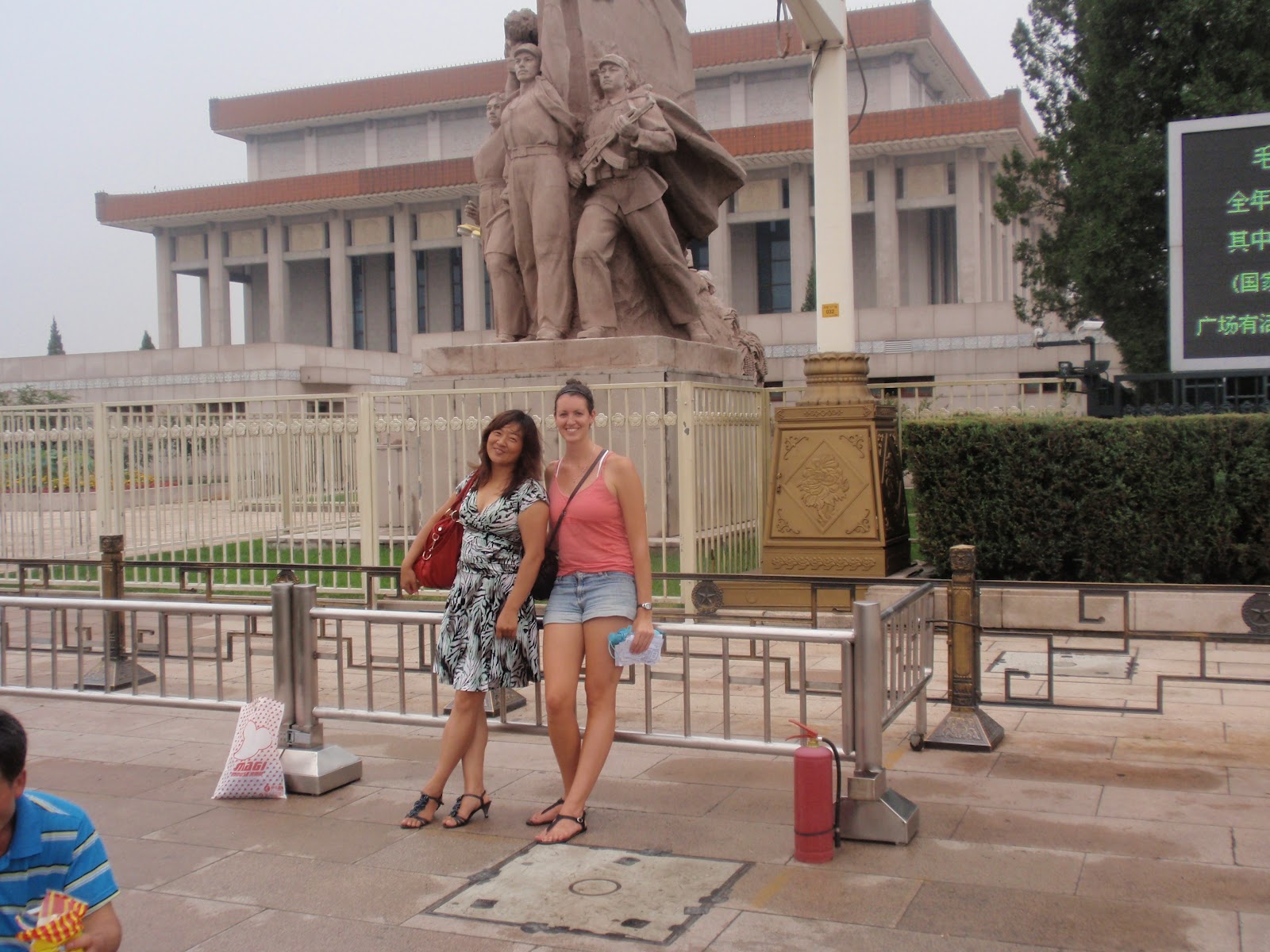
My first day in Beijing I did the two biggies: Tiananmen Square (from now on referred to as T-Square, since I always have trouble spelling it) and the Forbidden City. T-Square was…big. That’s really the best way to describe it. It takes about ten minutes to walk from one side to another, which is exactly what I did. I took the obligatory picture with Mr. Mao, and even got asked to have a picture taken with this lovely lady here to the left, as I was taking a break to look at my map. 

The Forbidden City was incredibly impressive, and enhanced by my pre-China viewing of "The Last Emperor." Those Chinese emperors sure knew how to live in style. From the Hall of … to the Hall of …, I just walked around, took pictured, dodged zillions of tourists (just like me, of course) and found peace in my favorite part of the Forbidden City, the Imperial Gardens. The mistresses knew how to live in style too. Back there I was best able to think back about 500 years and imagine how pleasant it must have been to be royalty…aside from the backstabbing and affairs and such, of course. 

My favorite day of the whole time in Beijing was the Great Wall Day. Upon recommendation by my friend, I booked a tour through my hostel, as much as I like to do things on my own. Our hostel took us past the very busy section of the Wall to a more remote, farther back part of the Wall – part of which had been destroyed by the Mongols just a few centuries earlier. We were blessed with extremely good weather – the best I’d seen in over a month. After a quick orientation and some information from our guide, we were let loose to roam free for a good three hours to take pictures, wander, and enjoy the wall with only about twenty other people. And last, as was my intention ever since I moved to Asia, I was able to replicate my mom’s Great Wall picture from 28 years ago! I even whipped out the raincoat for effect, even though it definitely wasn't cold nor raining. The sheer greatness and impressiveness of the Wall, which was built over the span of two thousand years from modern day XiAn to past Beijing, was incredible to observe firsthand. 


My last day had a profound impact on me and my perception not only of China, but of the part of the world I was in and where I was headed to. After wandering through the Temple of Heaven complex, (where the emperor used to go pray to the heavens for a good harvest every fall) I made my way back to T-Square for better pictures, and to go to the National China Museum.


Of course, I’m a museum nerd, so it’s only natural that I wanted to head there, but I was also curious to see this particular museum, as it was put up by the National Government of China – which is still communist. They controlled what you read, saw, and learned. As Americans, most of us have grown up with the perception: communism = bad. Yet, as I looked around these cities, with their Gucci and Prada stores, I kept thinking ‘all our perceptions of communism don’t seem to be playing out in this country, right here and now.’ The horrors of the Great Leap Forward failure and the years of famine during Mao’s early leadership seemed to be only memories of the past as I looked around modern China.

But then I went to the museum. The bottom floor was the ‘Ancient China’ exhibit, which was a beautiful display of Chinese bronzes, pottery, ceramics, etc., that ran the course of history from pre-civilization to the proclamation of the Republic in 1911. From there, I went upstairs, and after gawking at the revolutionary Mao portraits (quite reminiscent of the French Revolutionary portraits I remember studying in high school) displayed gallantly in a red exhibit room, I made my way to the side wing, entitled the “Road to Rejuvenation.”

This was what I had come to see. In honor of the 100 years of the Republic, (made official in 1912) the display covered everything from the start of the party, led by Dr. Sun Yat-Sen, all the way to the current president Hu Jintao. I was most fascinated by the English translations on the display panels. For example, “the founding of the CPC was an earth-shattering event that brought new vitality to the Chinese revolution,” or how about “socialism is the only way to save China.”


This was verbatim ‘revolutionary’ propaganda that I had read about in history books, phrases desiged to evoke emotions and instill patriotism in all loyal civilians, and I was seeing it for my very eyes. I almost got swept up in it, but my mind wouldn’t let me forget the horrors of the Great Famine and the purges, in which millions of innocent Chinese civilians died. Had it been worth it, in a country so big as China? Were the people happy they were living in communism, with limited freedoms such as YouTube and Facebook? Or were they happy, because they didn’t know anything differently? These questions and dozens more were spinning through my head as I left the museum, hurting my brain. 

T-Square as seen from the museum
Once again, Beijing earned my deepest respect for not only wearing out my feet, but wearing out my thinking cap as well. All of my studying had paid off to paint a pretty good picture of Chinese history in my mind, solidified by my museum visit.  I hope that I can take that knowledge, especially as I head to Southeast Asia to see more countries affected by communism, and use it to help answer some of my endless questions about its place in the modern world. But first, I had a little more of China to see.

Monday, September 10, 2012

Xian: A City of Contrast.


To me, Xian is the single most important city in China, as the old capital of a civilization rivaling only that of ancient Rome. It is where classical Chinese script originated, where the Han dynasty was founded, and where Buddhism and Confucianism first took root in China. It remained the imperial capital through eight dynasties, and became home to the crossroads of the thriving Silk Road. It was, and still is, a magnificent display of historical, cultural, and imperial significance...not to mention its consumer culture significance, with  designer stores, massive shopping compounds, and a McDonalds and KFC on every corner.

Perhaps today its importance as a major Chinese city is eclipsed by Beijing and Shanghai, but ask any Chinese person who lived 1,000 years ago, and they would have told you Xi An, (or Chang An, as it used to be called) was the place to be. Today, the most standout sight that people (okay, tourists) go to Xi An for is the site of the Terra Cotta Warrior army. And that is precisely where I found myself on my second morning in China, after a long 12 hour travel day the day before from Hong Kong.

But before we get into talking about 2,000 year old statues, (you can't wait, I know) let me share with you some of my first impressions of China, a country I've wanted see since before I can remember.
As I stepped off the plane and followed the very convenient signs to the airport to city bus, bought my ticket, and waltzed on the bus, (the exact repeat of how I had gotten to the airport from Hong Kong in the first place, waltzing and all,) I very distinctly remember thinking "This too easy. I want to be challenged, I'm supposed to be traveling in CHINA, being hot and smelly with about a million other people who don't speak English, crowded every which way, and not zipping around in air conditioned buses." Little did I know that somebody upstairs definitely heard my thoughts, and decided they would make me eat my words in a very short time.

I stepped off the bus, saw the landmark my hostel directions had noted, and set off walking. The broad, paved streets and wide sidewalks lined with shops accented the hustle and bustle of a big city – with 7 million inhabitants, I suppose it has a right to act like one. However, there were definitely signs that I wasn’t in Kansas anymore. The actual signs, for one, written in Chinese, but thankfully some had English below them. Another thing was the mass quantity of motorscooters and bicycles, in their own little traffic lane. And last, as I made my next turn into what turned out to be the Muslim Quarter, not my hostel’s street, I realized that I was most definitely somewhere new. My thoughts changed to: “This is going to be fun.”
But remember when I said I thought things were too easy? My thoughts changed precisely, one more time, when I followed both the guide map I had with me and the written hostel directions, and wound up lost not once, not twice, but three times. New thoughts: “You’re an idiot. China is hard.” Luckily everyone at the other hostels I managed to find were kind and helped guide me in semi-the-right direction, at least far enough for me to ask another person. 

I finally made it after a good hour of traipsing around in the opposite direction of where I was supposed to go, but the good thing was that at least I orientated myself a little better around the city. After I dropped off my stuff, took a shower, and had some time to settle, I got my ticket to Beijing straightened out at the hostel desk, and decided I’d had enough adventure for one day, so stayed in the hostel to chat and get a feel for China from other travelers who had been in the country longer. 

The next day was really exciting for two very important reasons. First, I finally got to see the Terra Cotta Warriors, imprisoned under the earth for over 2,000 years until about 30 years ago. Second, I discovered Chinese breakfast street food. I’ll start with that. 

My excitement began bright and early as I got up and got myself ready early, ready to head to the bus terminal and catch a bus to see the warriors. As I tromped down the street towards the East Gate (one nice thing about Xian is that the inner city is surrouded by these walls, so if you ever get lost you just have to walk until you hit a wall,) I walked by a curious looking stand with people lined up behind it. Eggs, chopped veggies, processed meat, and other items I don’t think I can name were all set up neatly in little metal bowls next to a fry griddle, manned by an older man or woman who was cooking up something that looked really unhealthy…therefore delicious. And just a few meters down? A different yummy looking thing. I picked the one with the least people in line, paid my 3 yuan (about 40 cents) and happily munched on my breakfast, swinging the little plastic bag it comes in just like everyone else striding down the sidewalk, looking like they had places to be. Think something like a breakfast omelette with some sort of spicy sauce and Spam in it. Delight. (apologies for not having an appropriate picture for you – I didn’t want to interrupt the masters at work - but the woman sitting on the right of that picture kind of resembles a breakfast street vendor.) Too bad finding coffee wasn’t as easy as finding breakfast.


But enough about that, let’s get to the statues. A walk, a bus ride, and a long line of tourist hawkers that you have to walk through to get to the entrance later, and I was about to  enter the site that, only 35 years earlier, was countryside and a potential well. In March 1974, a group of farmers was digging a well when they happened upon, according to Wikipedia, “the largest pottery figurine group ever found in China.” 
Built and structured to protect the Emperor Qin, the ruthless yet brilliant Emperor responsible for the modern name China, (Qin is pronounced “Chin”) the warriors were buried sometime around 240 BC, but since then have been destroyed by plunderers and pillagers, leaving them broken and damaged. Restorers have worked to painstakingly reconstruct the life sized statues, of all various military dress such as General and Archer, “from the fragments of the crushed figures.” This guy was one of my favorites, the Warrior figure, on display in his own case. 

After many a History Channel documentary, to finally see the warriors in person brought me chills. They were magnificent, lined up in rows in a huge pit that is yet to be fully excavated. There were actually three pits, but I saved the largest and most impressive one for last. Though I had to deal with being pushed and shoved by frantic Chinese tourists scrambling to get pictures with their camera, videocameras, iPhones, iPads, you name it, I was still taller than all of them…so I won. I also put my headphones in to drown out the tour guides yapping and the mass of people running around. Double win. 


When I came back from the Warrior site, I decided to brave the crowds and take a wander through the Muslim Quarter again, since this time I was neither lost nor weighed down by all my stuff. It was a fun wander, with tons of food stall, souvenir shops, and a mess of people. The architecture was a mixture of Islamic, Chinese, and what I presumed to be Central Asian. Here is my new friend who caught me taking a picture of the pretty Arabic script behind her, and then proceeded to take my camera and take a picture of me holding one of her sweets that she shoved in my hand for a prop. 

As touristy as the Muslim Quarter was (note the bright neon signs) I appreciated it for still existing, for it represented the medieval, multicultural capital as a result of the Silk Road. Muslims came to Chang An over 1,000 years ago to trade and establish an important part of world history, so to still see their integration and influence in this little pocket of Chinese society was pretty cool. The words of one of the displays at the Xian Museum summed up a description of Chang An nicely: "with the opening of the Silk Road, the city has become the first international metropolitan in Chinese history, and has been known as an oriental capital of civilization." The street food wasn’t bad either. 

On my last morning in Xian, I braved the rain (after getting caught without an umbrella, during which I composed some of this blog on my iPod in an underground metro tunnel) and walked a short distance to see the Little Goose Pagoda. To my delight, it was now a (free) museum complex, which included a beautiful garden, the pagoda, the temple it is attached to, and the Xian History Museum. Ohhh. 

I started with the gardens and temple complex, which I had mostly to myself at 9 in the morning, except for a handful of elderly people doing their tai chi thing. As I walked through the pretty, peaceful grounds, I came across some Buddhist statues from about 700 AD, according to the plaque. It was right then that it hit me: This was Xian, former capital, where Chinese civilization as I knew it had been founded. Here was history, right in front of me, a testament to the strength and power of the ancient Chinese for creating a long lasting society, which has been modified and adapted to the changing times. That was why I was here, that was why I came to China, to see how the past has fused with the present. But for me at that moment, only the past existed.


So, from Muslims to Buddhists, from 2,000 year old guy statues to old guys selling breakfast on the streets, my introduction to China was pretty interesting. It definitely laid the framework down for what was to come, and it helped concrete a solid picture of where China began and how far it has come since then.


Beijing is up next! I hope your September is off to a lovely start!