A saying as ubiquitous as 'Hakuna Matata', 'Pura Vida' (pure life) is a
common phrase that Costa Ricans, or Ticos, use as a greeting, a goodbye, or just
when they feel like saying it. My time in Chilamate, Costa Rica, was about as
close to living 'la pura vida' as I could get. I had a simple room surrounded by
nature and wildlife, I had a place to be everyday with people I enjoyed working
with, I went to bed early and woke up with the sun (the roosters gave me no
choice on that one), I ate fresh local food, and in my free time I was
Internet-free, which meant I could read, write, and relax at my leisure. I even
had access to a hammock.
The Sarapiqui Conservation and
Learning Center,
where I chose to spend my time for a month, was a fantastic experience, and
everything I could have ever wanted from a volunteer trip. I knew I’d end up in Costa Rica for the family trip at the time I wanted to volunteer, so I began looking for
opportunities in Costa Rica. I ended up finding the SCLC on a website resource,
and contacted the volunteer coordinator almost a year in advance. Everything
went through, I booked my plane ticket, and I was set for a month of working in
rural Costa Rica, while living with a host family. Originally
my intention was to work as an assistant English teacher, since the Center
offers community English classes, but as the time grew closer the coordinator
contacted me and said I would be needed more in the tourism department, as
March was a busy month for the Center. I had no idea what that meant, but
figured I should be up for anything, and either way I’d be learning something.
 |
| The Sarapiqui River |
Sarapiqui is the area surrounding the Sarapiqui River, and Chilamate is the very small little community area where my house and the Center were actually located within Sarapiqui. The area falls under what is called the MesoAmerican Biological Corridor, an area that extends from Mexico throughout Central America, which has been designated to protect certain endangered species.The Center’s Mission Statement is
as follows: “The SCLC focuses its efforts in four areas — environmental
education, community development, conservation, and tourism — in order to help
form future environmental leaders, raise the organizational capacity of local
communities, promote sustainable land use, and connect tourists to the local
community.”
 |
| Rosy's house - my cabina is directly to the left . |
I didn’t really know what
that meant in terms of how I would be put to work, but I found out on my very
first weekend in Chilamate. After saying goodbye to my family in San Jose, I took a very
overpriced taxi to the Caribbean Bus Terminal, where buses travel east towards
the Caribbean Coast, and I caught my bus for Puerto Viejo, about two hours from
the capital. I was greeted at the terminal by Yazmin, the volunteer coordinator
whom I’d been corresponding with, and Jasmin, another long term volunteer. The
short term volunteers (like me) paid for their own accommodation with a host family,
while the long term volunteers received room and board for free, provided they
stay for a minimum of six months. Yazmin had purposely wanted me to arrive on a
Friday so that I’d have the weekend to settle in, so that evening I was taken
to my ‘cabina,’ which was just one room with a bathroom attached (luxury
compared to sharing hostel dorm rooms!) and introduced to my host mom Rosy, and
her three sons – for more pictures see the Welcome to Chilamate post. After dinner,
some chatting (I put my rusty Spanish to use and apologized profusely for all
of my mistakes), and some organizing in my cabina I was ready for bed, and glad
for the alone time I’d be getting in the mornings and evenings after six weeks of traveling with people and
staying in hostels.
 The next morning I was taken to the
Center, just a ten minute walk down the road, by Cena and Sarah, two other long
term Canadian volunteers who lived just a few feet away from my cabina. Cena
was in charge of the Saturday morning English classes for kids, so she brought
me along so that I could observe and help out if needed. This is the Center:
the lower level had a large classroom and the library, while the upstairs had
three offices and another classroom. The volunteers could do their work in the volunteer office upstairs or the library, but most of us preferred to work here:
The next morning I was taken to the
Center, just a ten minute walk down the road, by Cena and Sarah, two other long
term Canadian volunteers who lived just a few feet away from my cabina. Cena
was in charge of the Saturday morning English classes for kids, so she brought
me along so that I could observe and help out if needed. This is the Center:
the lower level had a large classroom and the library, while the upstairs had
three offices and another classroom. The volunteers could do their work in the volunteer office upstairs or the library, but most of us preferred to work here:  |
| "Welcome to The Office" |
The classes were fun, I was
thrilled with the selection of English books in the library, and the Center was
perfectly situated along the beautiful Sarapiqui River, with sounds of tropical bugs, birds, and even the occasional howler monkey in the air. I knew I was going to like it
there. That night we had a bit of a get together, and I was able to meet the
rest of the volunteers and some of the community members. That Sunday I was
taken to a local peppercorn farm, where I learned about the ‘tourism’ aspect of
the Center. Basically, the SCLC is on the property of the Selva Verde Lodge, a popular destination for nature and birdwatching buffs. Through the Lodge the guests can book tours (or they stop at Selva Verde within their tours of Costa Rica) to learn more about the local community, such as taking cooking classes, taking Latin dance classes, visiting the peppercorn farm, or listening to a 'charla' (chat) about life in the community. Sarapiqui is one of the poorest counties in Costa Rica, and the way of life is still very rural and agrarian based in some of the nearby communities.
 |
| This is where your pepper comes from! |
That's where the SCLC volunteers come in. We act as facilitators between the tourists and the community members, which usually involves some form of translating, some group leadership, and keeping the tour running smoothly. Here is a picture of Justine, a French SCLC
 volunteer, acting as a translator for the tourists and Mazarella, the owner of the peppercorn farm. She not only translates what Mazarella explains, but she translates questions between the tourists and Mazarella. The tour was very interesting, but a little worrying for me, because I knew that was what I would have to be doing once Justine left shortly after I arrived. I ended up not having to do the peppercorn farm tour, but I did take over as the 'community talk' translator - it was an excellent challenge for me in terms of putting my Spanish to use, and the tourists were so appreciative and eager to learn more about life in Costa Rica. For the following week or so I observed the tours and chats while taking notes, so that once Justine left I'd be ready.
The volunteers were generally expected at the Center from
9-5, and we all rotated reception duty and kitchen duty throughout the week.
The Center bought their local fruits and vegetables from a vendor on Monday
mornings, which would last us the week, and then whoever was on cooking duty
for lunch was just encouraged to ‘be creative’ and whip something up with what
we had. If we needed basic ingredients, we'd phone the little convenient store down the road to deliver to us. Unfortunately there was no local take out to rely on if we screwed up. Luckily we were all up to the challenge and produced
masterful, elaborate dishes that should have been featured on a TV show.
 |
| My lovely little library. |
Aside from becoming the next Master Chefs, if there wasn’t a
tour group or activity booked, we usually
had a lot of down time during which we were responsible for keeping ourselves
busy with work or helping out with random odd jobs at the Center. If you were on reception duty, you sat at the desk and answered phone calls (a little scary if you encountered a rapid-fire Spanish speaker), and kept an eye on the kids who signed themselves in to use the Center's computers. We also had weekly staff meetings once a week, where we all updated each other on the progress of our current projects.
Sometimes in the evenings I either subbed or just stopped in for observation and for fun at some of the adult evening English classes. I was permitted to teach a lesson or two, and enjoyed being an extra English teacher to circulate and help students with questions. It was great to be a teacher again, even for a short while. With the rest of my time, I worked on
making a tree guide for a reforestation activity (I’ll explain that in a minute),
brushing up on my Spanish, and organizing the library. The library was a really fun project for me to work on, and I was able to see it most of it through to the end.
Here is a little more about the library's history, posted on the Center's website:
"The Sarapiqui Conservation and Learning Center was
originally founded in 1993 as a local community library, with the vision to offer
educational opportunities to the neighboring area youth. Twenty years later,
the library is still a thriving center that boasts a variety of fiction and
nonfiction genres and titles in Spanish and English for all ages, from children
and young adult readers to adults. Computers are also available for homework
help and other resources."
 |
| After our seed collecting reconnaissance for the tour. L-R Me, Caitlin, Jasmin, Yazmin, and Max. |
So now that I’ve covered a little about the community
development (English classes and community tours), the tourism (peppercorm farm
tour, community chat, etc), let’s move onto the environmental education and
conservation. One of my main projects, along with Max, another short term
volunteer, and Yazmin, was to organize and implement a new reforestation tour,
using actual seeds and seedlings found on the grounds near the Center and the
Selva Verde Lodge. With the help of one the Lodge’s nature guys, Ivan, we
identified four main types of trees and seeds throughout the property, and made
a plan to split the students (from the tour group who had booked the project)
into four groups to actually collect the seeds, bring them back to the Center, and get them ready for planting. In the
afternoon the same students helped plant other seedlings at a local farm, to
help reforest the area. It was a pretty fun project to work on from start to
finish, and I’m glad I had a hand in helping out with it.
 |
| School painting. |
 |
| River cleanup trip. |
Two other activities I had fun helping with were a school
painting activity with a group of high schoolers from the East Coast and a
river rafting cleanup tour, when some of the local rafting guides took us down
the river with the intention to stop and pick up trash on the bank along the
way. There actually wasn’t that much trash, so we just had a fun morning on the river together. Most of the school tour groups (why March was such a busy month for the Center, due to all of the school groups who traveled to Costa Rica on their spring breaks for a volunteer trip) who participated in some of the community projects usually ended up doing a river rafting trip.
 And last, to round out the summary of my experience in
Chilamate, I have to talk about my time outside of the Center. Usually in the
evenings I’d stay to use the Internet or Skype, then by 6 I’d head back to Rosy’s
for dinner, as the sun was setting. After dinner and hanging out with the
family for a little bit, I’d head to my cabina to read, maybe watch a TV episode or two on my computer, and sleep early. On the weekends, if there wasn’t
a tour or activity booked, I’d have my own free time. If it was sunny, I’d lay
out by the pool at the Selva Verde Lodge, read in Yazmin or Cena/Sarah’s
hammock, or head to the Center to use the Internet or read. I remember feeling a little guilty for sitting in the sun and reading my book with Cena and Sarah instead of doing something active outside on some of the beautifully sunny weekend days we had, but as Cena put it: "lots of people from our countries pay hundreds of dollars to come to a place like this and do exactly what we're doing. We get to do it for free!" I felt less guilty after that.
And last, to round out the summary of my experience in
Chilamate, I have to talk about my time outside of the Center. Usually in the
evenings I’d stay to use the Internet or Skype, then by 6 I’d head back to Rosy’s
for dinner, as the sun was setting. After dinner and hanging out with the
family for a little bit, I’d head to my cabina to read, maybe watch a TV episode or two on my computer, and sleep early. On the weekends, if there wasn’t
a tour or activity booked, I’d have my own free time. If it was sunny, I’d lay
out by the pool at the Selva Verde Lodge, read in Yazmin or Cena/Sarah’s
hammock, or head to the Center to use the Internet or read. I remember feeling a little guilty for sitting in the sun and reading my book with Cena and Sarah instead of doing something active outside on some of the beautifully sunny weekend days we had, but as Cena put it: "lots of people from our countries pay hundreds of dollars to come to a place like this and do exactly what we're doing. We get to do it for free!" I felt less guilty after that.
 We ended up having a party every other weekend: the first on the weekend I arrived at the Center, the
next a birthday party, and the last a multi-occasion
goodbye/birthday/engagement celebration/vacation party. They all consisted of
hanging out together, having some adult beverages, and ending up at the local
karaoke bar across the street. It was good, old-fashioned fun with the volunteers
and some of our local friends, which involved a fun mix of Spanish and English,
North American and Costa Rican food, and Spanish and English dance music. The
multi-celebration party was thrown by one of the volunteer’s host moms, which
started out as a dinner party, turned into a clear-the-tables-and-dance party.
It was one of my last days in Chilamate, and it was the best way to spend it
before having to say goodbye. We had a fun group of volunteers who all worked
well together, and we were surrounded by so many welcoming community members. I
couldn’t have asked for a better experience, and hope someday I can return to
say hello and revisit some of my favorite places.
We ended up having a party every other weekend: the first on the weekend I arrived at the Center, the
next a birthday party, and the last a multi-occasion
goodbye/birthday/engagement celebration/vacation party. They all consisted of
hanging out together, having some adult beverages, and ending up at the local
karaoke bar across the street. It was good, old-fashioned fun with the volunteers
and some of our local friends, which involved a fun mix of Spanish and English,
North American and Costa Rican food, and Spanish and English dance music. The
multi-celebration party was thrown by one of the volunteer’s host moms, which
started out as a dinner party, turned into a clear-the-tables-and-dance party.
It was one of my last days in Chilamate, and it was the best way to spend it
before having to say goodbye. We had a fun group of volunteers who all worked
well together, and we were surrounded by so many welcoming community members. I
couldn’t have asked for a better experience, and hope someday I can return to
say hello and revisit some of my favorite places.
 And last, to round out the summary of my experience in
Chilamate, I have to talk about my time outside of the Center. Usually in the
evenings I’d stay to use the Internet or Skype, then by 6 I’d head back to Rosy’s
for dinner, as the sun was setting. After dinner and hanging out with the
family for a little bit, I’d head to my cabina to read, maybe watch a TV episode or two on my computer, and sleep early. On the weekends, if there wasn’t
a tour or activity booked, I’d have my own free time. If it was sunny, I’d lay
out by the pool at the Selva Verde Lodge, read in Yazmin or Cena/Sarah’s
hammock, or head to the Center to use the Internet or read. I remember feeling a little guilty for sitting in the sun and reading my book with Cena and Sarah instead of doing something active outside on some of the beautifully sunny weekend days we had, but as Cena put it: "lots of people from our countries pay hundreds of dollars to come to a place like this and do exactly what we're doing. We get to do it for free!" I felt less guilty after that.
And last, to round out the summary of my experience in
Chilamate, I have to talk about my time outside of the Center. Usually in the
evenings I’d stay to use the Internet or Skype, then by 6 I’d head back to Rosy’s
for dinner, as the sun was setting. After dinner and hanging out with the
family for a little bit, I’d head to my cabina to read, maybe watch a TV episode or two on my computer, and sleep early. On the weekends, if there wasn’t
a tour or activity booked, I’d have my own free time. If it was sunny, I’d lay
out by the pool at the Selva Verde Lodge, read in Yazmin or Cena/Sarah’s
hammock, or head to the Center to use the Internet or read. I remember feeling a little guilty for sitting in the sun and reading my book with Cena and Sarah instead of doing something active outside on some of the beautifully sunny weekend days we had, but as Cena put it: "lots of people from our countries pay hundreds of dollars to come to a place like this and do exactly what we're doing. We get to do it for free!" I felt less guilty after that. 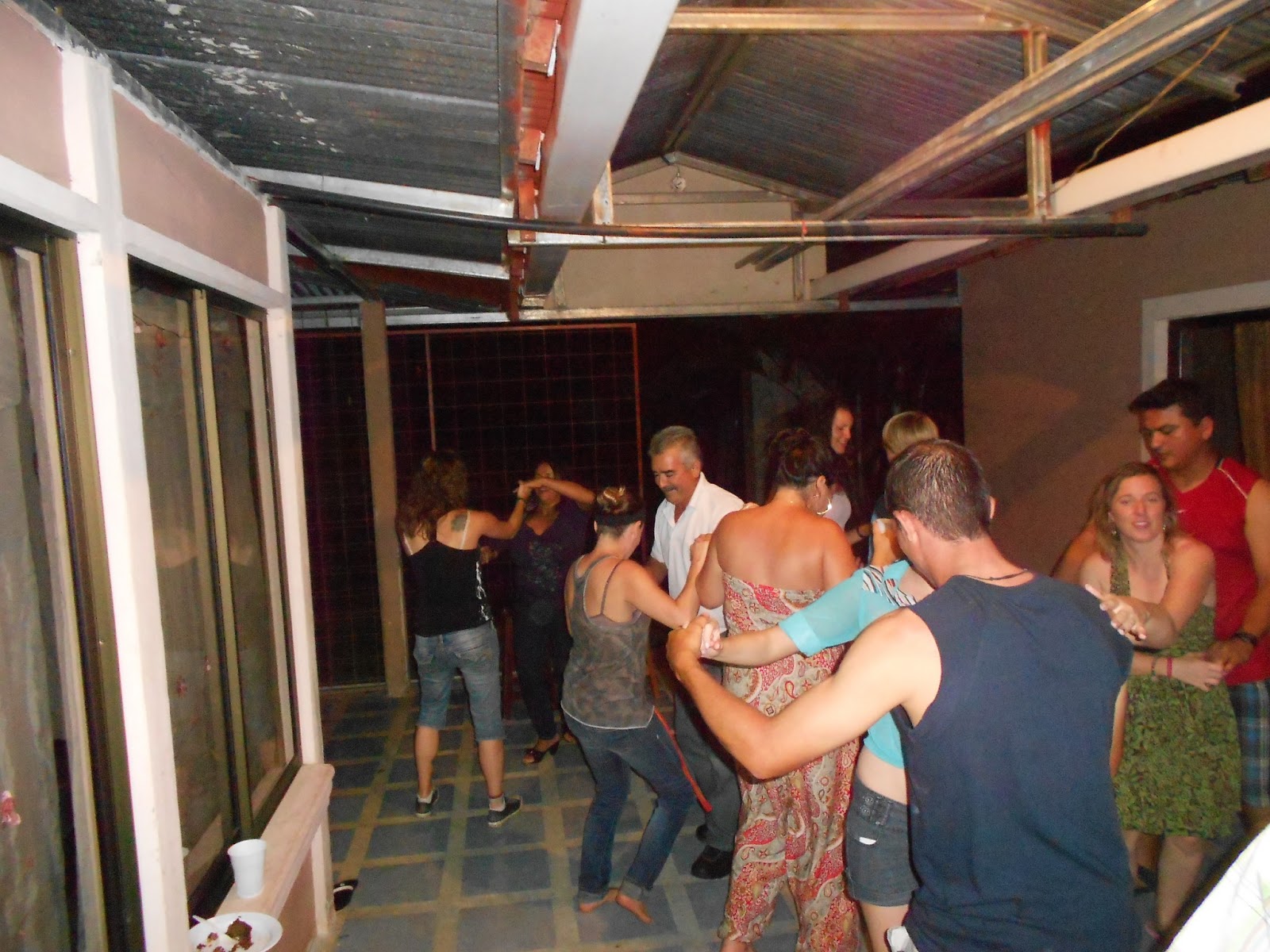 We ended up having a party every other weekend: the first on the weekend I arrived at the Center, the
next a birthday party, and the last a multi-occasion
goodbye/birthday/engagement celebration/vacation party. They all consisted of
hanging out together, having some adult beverages, and ending up at the local
karaoke bar across the street. It was good, old-fashioned fun with the volunteers
and some of our local friends, which involved a fun mix of Spanish and English,
North American and Costa Rican food, and Spanish and English dance music. The
multi-celebration party was thrown by one of the volunteer’s host moms, which
started out as a dinner party, turned into a clear-the-tables-and-dance party.
It was one of my last days in Chilamate, and it was the best way to spend it
before having to say goodbye. We had a fun group of volunteers who all worked
well together, and we were surrounded by so many welcoming community members. I
couldn’t have asked for a better experience, and hope someday I can return to
say hello and revisit some of my favorite places.
We ended up having a party every other weekend: the first on the weekend I arrived at the Center, the
next a birthday party, and the last a multi-occasion
goodbye/birthday/engagement celebration/vacation party. They all consisted of
hanging out together, having some adult beverages, and ending up at the local
karaoke bar across the street. It was good, old-fashioned fun with the volunteers
and some of our local friends, which involved a fun mix of Spanish and English,
North American and Costa Rican food, and Spanish and English dance music. The
multi-celebration party was thrown by one of the volunteer’s host moms, which
started out as a dinner party, turned into a clear-the-tables-and-dance party.
It was one of my last days in Chilamate, and it was the best way to spend it
before having to say goodbye. We had a fun group of volunteers who all worked
well together, and we were surrounded by so many welcoming community members. I
couldn’t have asked for a better experience, and hope someday I can return to
say hello and revisit some of my favorite places.
I once tried to work out in my head just how many people in
the local community are affected and helped by the Center and its efforts. Allow
me to share my thoughts with you. For starters, there are all of the host
families who receive an income from the short term volunteers who pay them for
room and board. Then there are all of the little local establishments such as
the convenient store, the grocery store, the buses, and the karaoke bar that
benefited from the volunteers living in the area and spending a little money
here and there. Next, the fruit and vegetable vendor, the maintenance man, the
convenient store, the delivery boy, the Internet cable company, the electric
and gas company, and I’m sure a few others received an income from the Center
staying open and running smoothly. All of the English students learned a skill
that could potentially help them find a tourism job, the Lodge was busier
because of the tourists who booked tours that the Center put on, the whitewater
rafting company received more tours from the school group tours who came to the
Center, there was a local women’s group who sold their handicrafts at the
Center, the children who came to the Saturday classes learned English, some of
the kids who came to use the computer received homework help or had fun with
the computer games. Last, the community
members who did the talks, hosted tours at their farms, led the dance lessons,
led the cooking lessons, and helped with the community service projects received
an income from the tourist money. I’m so proud to have been a small part of
these incredible efforts to help improve and sustain the community members of
Chilamate and the surrounding area. I learned so much, improved my Spanish, had
fun, helped others, made new friends, and, most importantly, embraced ‘la pura vida.’


