Showing posts with label Costa Rica. Show all posts

Thursday, May 30, 2013

Flashback Series: If You Were a Tico or Tica


Spending a month in Sarapiqui and living with a host family taught me a great deal about Costa Rica and its culture. I was pretty isolated in Chilamate, without doing much sightseeing, but that gave me a chance to really experience the life of a Tico. The name Tico, a general term for a Costa Rican (I thought this might just be a term foreigners call Costa Ricans, but I was actually corrected by my host mom to just say 'Ticos'), comes from the diminutive in the Spanish language that Ticos tend to add to most words. For example, the word gato means cat in Spanish, but gatito means little cat, or kitten. Ticos tend to add the diminutive to words like ahora, which means now. 

"Hola, when is the bus coming?" 
"Ahorita." 
"What? Ohh, you're speaking Tico Spanish."

Costa Rica means 'Rich Coast' in Spanish, named by Christopher Colombus himself after he had a brief stopover in 1502. Of course, Costa Rica had native inhabitants long before Colombus arrived, (clad in gold jewelry, which was why he called it 'rich') but once it was put on Spain's map it wasn't left alone for much longer. Conquistadors arrived in pursuit of the gold that drove them in hordes across the Atlantic, but despite its promising name, Costa Rica yielded very little gold, and instead turned into a killing ground for the natives. Most of those that the Spaniards did not murder died of smallpox, leaving only 1 percent of today's population of indigenous heritage. The rest of the population is of Spanish descent, with another small percentage of Africans, after the Spanish brought them over as plantation slaves. 

After the initial bloodshed, Costa Rica has had a pretty turbulent-free history, due to its lack of gold and silver. There was a brief civil war between the four main emerging republics in the Central Valley, with two of them wanting to be a part of Mexico and two wanting to be independent, which resulted in a republican victory and a sovereign state in 1823. Since then, aside from a few skirmishes, it has become one of the more prosperous Central American countries, financed in the late nineteenth century as one of the original 'Banana Republics', under the United Fruit Company. This monopoly led to the building of railways to transport primarily bananas to the coasts, which led to increased trade and prosper. Today bananas remain one of Costa Rica's top exports, along with pineapple and coffee beans.  

Their national dish is gallo pinto, which is black beans, rice, and onion fried together. My host mom made this for breakfast every morning, along with freshly filtered coffee, and sometimes half an avocado or a fried egg. Other typical foods include arroz con pollo, or rice with chicken (along with other vegetables), empanadas (fried deliciousness stuffed with more deliciousness), and various dishes made with potatoes, yucca (cassava) or plantains, which are a larger, more starchy version of bananas. Cilantro and lime aren't unusual flavors to find in most Tico dishes. And of course, there is always an abundance of fresh tropical fruits such as papaya, pineapple, mango, and bananas available. Needless to say, I ate well in Costa Rica. 

Today Costa Rica is very Westernized, and a mecca for tourists seeking mostly nature-oriented vacations, thanks to its status as "one of the 20 countries with the highest biodiversity in the world." (Wikipedia) I just learned that the new Will Smith movie "After Earth" was filmed primarily in Costa Rica, some of it in Sarapiqui. To the Ticos who live in 'la selva,' or 'jungle' climates, tropical animals, insects, birds, and bugs are just another part of their everyday life. Machetes are not uncommon for whacking down persistent weeds, plants, or just to have on hand for a random snake encounter. I remember my first weekend in Sarapiqui I went for a walk and encountered a bright green and black poison arrow dart frog. I was immediately taken back to my childhood when my brother and I had an 'I Spy' rainforest book, where we had to look for the very same dart frog that was jumping right in front of me. I most definitely was not in Minnesota anymore.

To give you more of an idea of living in Chilamate, here are some pictures to help illustrate your life if you were a Tico living in 'la selva.' 

For starters, you might see this view on a hike in a nearby nature reserve...


Or you might run into one of these poison arrow dart frogs on the same hike.


You might eat afternoon snacks like this fresh off the tree...


Or you might be eating patacones, or fried plantain chips, with fresh guacamole.


You might have this as your weekend swimming pool...


You might see this when the sun sets over your back yard...


Or you might have this as your front yard. 


You might see an iguana hanging out on a nearby tree...


Or one of these guys when you look out of your window at work...


Or a Golden Orb spider making one of its elaborate webs.


 And this might be on the side of the road.


You might cook your food in a wood-fired oven like this...


Or you might see one of these on your walk home.


But most importantly, you might make friends with wonderful, warm, loving, and caring Ticos like these...and then you would be a very, very lucky person. 


Pura Vida. 

Tuesday, May 28, 2013

Flashback Series: La Pura Vida

A saying as ubiquitous as 'Hakuna Matata', 'Pura Vida' (pure life) is a common phrase that Costa Ricans, or Ticos, use as a greeting, a goodbye, or just when they feel like saying it. My time in Chilamate, Costa Rica, was about as close to living 'la pura vida' as I could get. I had a simple room surrounded by nature and wildlife, I had a place to be everyday with people I enjoyed working with, I went to bed early and woke up with the sun (the roosters gave me no choice on that one), I ate fresh local food, and in my free time I was Internet-free, which meant I could read, write, and relax at my leisure. I even had access to a hammock.

The Sarapiqui Conservation and Learning Center, where I chose to spend my time for a month, was a fantastic experience, and everything I could have ever wanted from a volunteer trip. I  knew I’d end up in Costa Rica for the family trip at the time I wanted to volunteer, so I began looking for opportunities in Costa Rica. I ended up finding the SCLC on a website resource, and contacted the volunteer coordinator almost a year in advance. Everything went through, I booked my plane ticket, and I was set for a month of working in rural Costa Rica, while living with a host family. Originally my intention was to work as an assistant English teacher, since the Center offers community English classes, but as the time grew closer the coordinator contacted me and said I would be needed more in the tourism department, as March was a busy month for the Center. I had no idea what that meant, but figured I should be up for anything, and either way I’d be learning something.
The Sarapiqui River
Sarapiqui is the area surrounding the Sarapiqui River, and Chilamate is the very small little community area where my house and the Center were actually located within Sarapiqui. The area falls under what is called the MesoAmerican Biological Corridor, an area that extends from Mexico throughout Central America, which has been designated to protect certain endangered species.The Center’s Mission Statement is as follows: “The SCLC focuses its efforts in four areas — environmental education, community development, conservation, and tourism — in order to help form future environmental leaders, raise the organizational capacity of local communities, promote sustainable land use, and connect tourists to the local community.” 

Rosy's house - my cabina is directly to the left . 
I didn’t really know what that meant in terms of how I would be put to work, but I found out on my very first weekend in Chilamate. After saying goodbye to my family in San Jose, I took a very overpriced taxi to the Caribbean Bus Terminal, where buses travel east towards the Caribbean Coast, and I caught my bus for Puerto Viejo, about two hours from the capital. I was greeted at the terminal by Yazmin, the volunteer coordinator whom I’d been corresponding with, and Jasmin, another long term volunteer. The short term volunteers (like me) paid for their own accommodation with a host family, while the long term volunteers received room and board for free, provided they stay for a minimum of six months. Yazmin had purposely wanted me to arrive on a Friday so that I’d have the weekend to settle in, so that evening I was taken to my ‘cabina,’ which was just one room with a bathroom attached (luxury compared to sharing hostel dorm rooms!) and introduced to my host mom Rosy, and her three sons – for more pictures see the Welcome to Chilamate post. After dinner, some chatting (I put my rusty Spanish to use and apologized profusely for all of my mistakes), and some organizing in my cabina I was ready for bed, and glad for the alone time I’d be getting in the mornings and evenings after six weeks of traveling with people and staying in hostels.  

The next morning I was taken to the Center, just a ten minute walk down the road, by Cena and Sarah, two other long term Canadian volunteers who lived just a few feet away from my cabina. Cena was in charge of the Saturday morning English classes for kids, so she brought me along so that I could observe and help out if needed. This is the Center: the lower level had a large classroom and the library, while the upstairs had three offices and another classroom. The volunteers could do their work in the volunteer office upstairs or the library, but most of us preferred to work here: 

"Welcome to The Office"
The classes were fun, I was thrilled with the selection of English books in the library, and the Center was perfectly situated along the beautiful Sarapiqui River, with sounds of tropical bugs, birds, and even the occasional howler monkey in the air. I knew I was going to like it there. That night we had a bit of a get together, and I was able to meet the rest of the volunteers and some of the community members. That Sunday I was taken to a local peppercorn farm, where I learned about the ‘tourism’ aspect of the Center. Basically, the SCLC is on the property of the Selva Verde Lodge, a popular destination for nature and birdwatching buffs. Through the Lodge the guests can book tours (or they stop at Selva Verde within their tours of Costa Rica) to learn more about the local community, such as taking cooking classes, taking Latin dance classes, visiting the peppercorn farm, or listening to a 'charla' (chat) about life in the community. Sarapiqui is one of the poorest counties in Costa Rica, and the way of life is still very rural and agrarian based in some of the nearby communities.

This is where your pepper comes from! 
That's where the SCLC volunteers come in. We act as facilitators between the tourists and the community members, which usually involves some form of translating, some group leadership, and keeping the tour running smoothly. Here is a picture of Justine, a French SCLC
volunteer, acting as a translator for the tourists and Mazarella, the owner of the peppercorn farm. She not only translates what Mazarella explains, but she translates questions between the tourists and Mazarella. The tour was very interesting, but a little worrying for me, because I knew that was what I would have to be doing once Justine left shortly after I arrived. I ended up not having to do the peppercorn farm tour, but I did take over as the 'community talk' translator - it was an excellent challenge for me in terms of putting my Spanish to use, and the tourists were so appreciative and eager to learn more about life in Costa Rica. For the following week or so I observed the tours and chats while taking notes, so that once Justine left I'd be ready.

The volunteers were generally expected at the Center from 9-5, and we all rotated reception duty and kitchen duty throughout the week. The Center bought their local fruits and vegetables from a vendor on Monday mornings, which would last us the week, and then whoever was on cooking duty for lunch was just encouraged to ‘be creative’ and whip something up with what we had. If we needed basic ingredients, we'd phone the little convenient store down the road to deliver to us. Unfortunately there was no local take out to rely on if we screwed up. Luckily we were all up to the challenge and produced masterful, elaborate dishes that should have been featured on a TV show.

My lovely little library. 
Aside from becoming the next Master Chefs, if there wasn’t a tour group or activity booked,  we usually had a lot of down time during which we were responsible for keeping ourselves busy with work or helping out with random odd jobs at the Center. If you were on reception duty, you sat at the desk and answered phone calls (a little scary if you encountered a rapid-fire Spanish speaker), and kept an eye on the kids who signed themselves in to use the Center's computers. We also had weekly staff meetings once a week, where we all updated each other on the progress of our current projects.

Sometimes in the evenings I either subbed or just stopped in for observation and for fun at some of the adult evening English classes. I was permitted to teach a lesson or two, and enjoyed being an extra English teacher to circulate and help students with questions. It was great to be a teacher again, even for a short while. With the rest of my time, I worked on making a tree guide for a reforestation activity (I’ll explain that in a minute), brushing up on my Spanish, and organizing the library. The library was a really fun project for me to work on, and I was able to see it most of it through to the end. 

Here is a little more about the library's history, posted on the Center's website: 
"The Sarapiqui Conservation and Learning Center was originally founded in 1993 as a local community library, with the vision to offer educational opportunities to the neighboring area youth. Twenty years later, the library is still a thriving center that boasts a variety of fiction and nonfiction genres and titles in Spanish and English for all ages, from children and young adult readers to adults. Computers are also available for homework help and other resources."

After our seed collecting reconnaissance for the tour.
L-R Me, Caitlin, Jasmin, Yazmin, and Max.
So now that I’ve covered a little about the community development (English classes and community tours), the tourism (peppercorm farm tour, community chat, etc), let’s move onto the environmental education and conservation. One of my main projects, along with Max, another short term volunteer, and Yazmin, was to organize and implement a new reforestation tour, using actual seeds and seedlings found on the grounds near the Center and the Selva Verde Lodge. With the help of one the Lodge’s nature guys, Ivan, we identified four main types of trees and seeds throughout the property, and made a plan to split the students (from the tour group who had booked the project) into four groups to actually collect the seeds, bring them back to the Center,  and get them ready for planting. In the afternoon the same students helped plant other seedlings at a local farm, to help reforest the area. It was a pretty fun project to work on from start to finish, and I’m glad I had a hand in helping out with it.

School painting.
River cleanup trip.
Two other activities I had fun helping with were a school painting activity with a group of high schoolers from the East Coast and a river rafting cleanup tour, when some of the local rafting guides took us down the river with the intention to stop and pick up trash on the bank along the way. There actually wasn’t that much trash, so we just had a fun morning on the river together. Most of the school tour groups (why March was such a busy month for the Center, due to all of the school groups who traveled to Costa Rica on their spring breaks for a volunteer trip) who participated in some of the community projects usually ended up doing a river rafting trip.

And last, to round out the summary of my experience in Chilamate, I have to talk about my time outside of the Center. Usually in the evenings I’d stay to use the Internet or Skype, then by 6 I’d head back to Rosy’s for dinner, as the sun was setting. After dinner and hanging out with the family for a little bit, I’d head to my cabina to read, maybe watch a TV episode or two on my computer, and sleep early. On the weekends, if there wasn’t a tour or activity booked, I’d have my own free time. If it was sunny, I’d lay out by the pool at the Selva Verde Lodge, read in Yazmin or Cena/Sarah’s hammock, or head to the Center to use the Internet or read. I remember feeling a little guilty for sitting in the sun and reading my book with Cena and Sarah instead of doing something active outside on some of the beautifully sunny weekend days we had, but as Cena put it: "lots of people from our countries pay hundreds of dollars to come to a place like this and do exactly what we're doing. We get to do it for free!" I felt less guilty after that. 

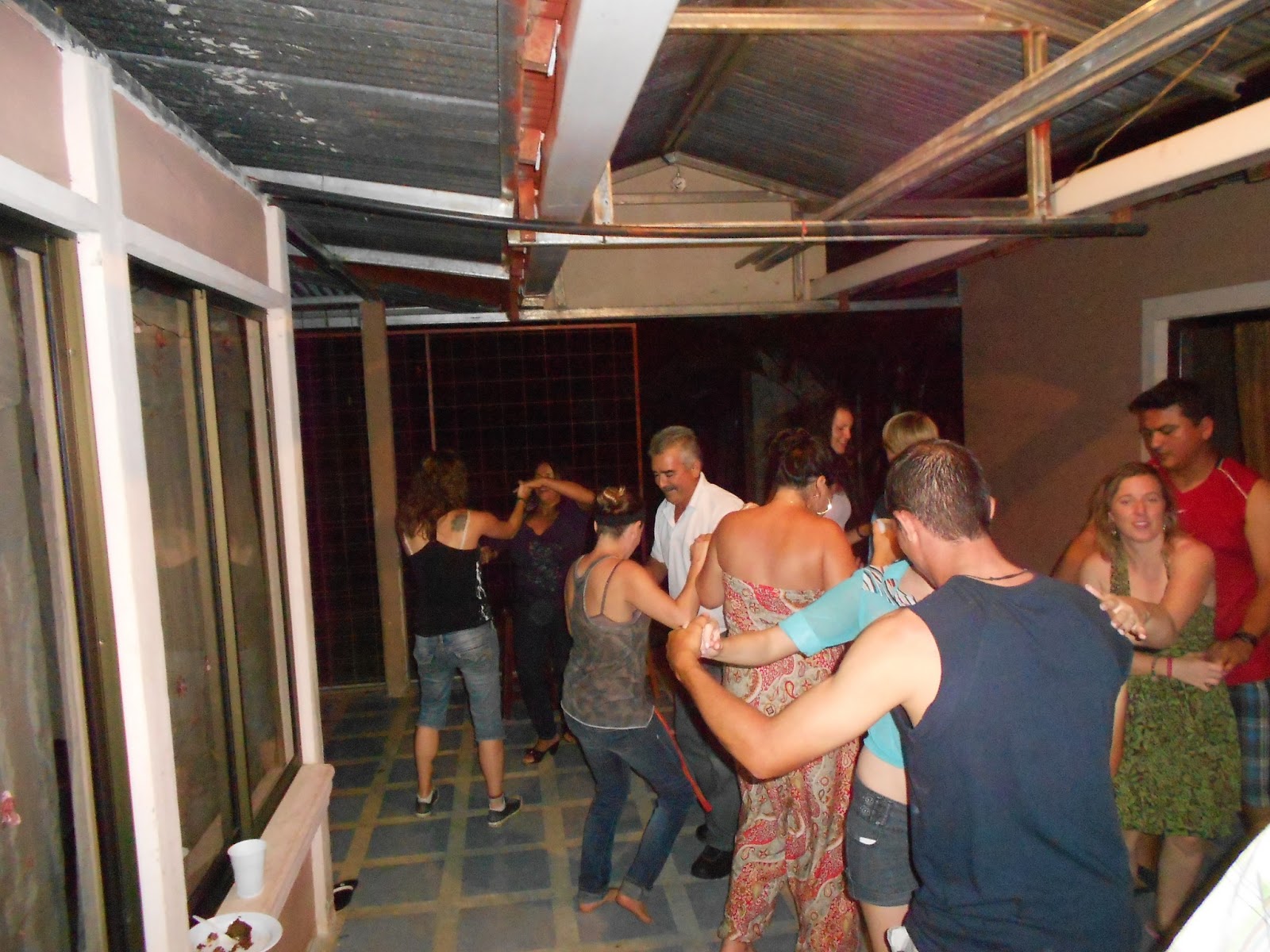
We ended up having a party every other weekend: the first on the weekend I arrived at the Center, the next a birthday party, and the last a multi-occasion goodbye/birthday/engagement celebration/vacation party. They all consisted of hanging out together, having some adult beverages, and ending up at the local karaoke bar across the street. It was good, old-fashioned fun with the volunteers and some of our local friends, which involved a fun mix of Spanish and English, North American and Costa Rican food, and Spanish and English dance music. The multi-celebration party was thrown by one of the volunteer’s host moms, which started out as a dinner party, turned into a clear-the-tables-and-dance party. It was one of my last days in Chilamate, and it was the best way to spend it before having to say goodbye. We had a fun group of volunteers who all worked well together, and we were surrounded by so many welcoming community members. I couldn’t have asked for a better experience, and hope someday I can return to say hello and revisit some of my favorite places. 

I once tried to work out in my head just how many people in the local community are affected and helped by the Center and its efforts. Allow me to share my thoughts with you. For starters, there are all of the host families who receive an income from the short term volunteers who pay them for room and board. Then there are all of the little local establishments such as the convenient store, the grocery store, the buses, and the karaoke bar that benefited from the volunteers living in the area and spending a little money here and there. Next, the fruit and vegetable vendor, the maintenance man, the convenient store, the delivery boy, the Internet cable company, the electric and gas company, and I’m sure a few others received an income from the Center staying open and running smoothly. All of the English students learned a skill that could potentially help them find a tourism job, the Lodge was busier because of the tourists who booked tours that the Center put on, the whitewater rafting company received more tours from the school group tours who came to the Center, there was a local women’s group who sold their handicrafts at the Center, the children who came to the Saturday classes learned English, some of the kids who came to use the computer received homework help or had fun with the computer games.  Last, the community members who did the talks, hosted tours at their farms, led the dance lessons, led the cooking lessons, and helped with the community service projects received an income from the tourist money. I’m so proud to have been a small part of these incredible efforts to help improve and sustain the community members of Chilamate and the surrounding area. I learned so much, improved my Spanish, had fun, helped others, made new friends, and, most importantly, embraced ‘la pura vida.’ 


Monday, May 27, 2013

Flashback Series: Journey From the Center of the Earth

In the time between leaving Rio and starting to volunteer in Costa Rica, I had three little mini trips to get from A to B. First, I flew back to Ecuador with Cecilia and we spent one last day together at the Equator, then I flew to Costa Rica and spent a few days on my own in Heredia, and last, I was spoiled with my family on vacation in Dominical. I went from friend travel to solo travel to family travel – quite the transitioning, but each experience just added to the variety of ways I was learning to enjoy exploring new places. 
QUITO

First, I had to say goodbye to my beloved travel companion Cecilia. After having one last airport sleepover (thank you cheap flights), we had a flight back to Quito, and got ourselves into the city center without a problem. We had booked an excellent hostel recommended to us by a girl in Rio, which was coincidentally right by the street where Kate’s iPhone had been stolen just a month earlier. But instead of revisiting our favorite places in Quito for our last day together, we had one final destination in mind: the center of the Earth.

High five for a trip well done, from both the Northern and Southern Hemisphere. 
Well, at least we can say we've been there,
even if it's not real.

I guess it was technically only the center of the Earth’s surface, but it’s still kind of true. Ecuador, which means Equator in Spanish, is situated directly on top of the Equator, but because of the high altitude of the Andes Mountains the air isn't boiling hot like most equatorial climates. The trip was only 40 minutes north of Quito by bus (we paid about 45 cents total) to reach the monument. There is a large monument with direction markers each way at the “Mitad del Mundo” (Half the World) complex, which includes tons of tourist shops, cafes, and a little central square. But of course the most important reason to visit the monument was to get a picture with one foot in the Northern Hemisphere and one foot on the Southern Hemisphere.

Hopefully none of the tourists who have that picture on their mantle read this, because the irony is that the Mitad del Mundo monument was built before GPS and modern technology…and it’s not on the true Equator. It’s close, but not quite exact. Luckily we were clued into this fact long before we started our trip, so as soon as we arrived at the monument, we followed the directions and walked around the park. After about ten minutes, we found the sign we were looking for then turned up a small little dirt road to the exact GPS positioned Equator, with a small, pretty little outdoor museum surrounding it. 

The Equator Museum was really interesting, with an admission ticket that included a guide through the museum about the native Ecuadorians (before the Inca, then Spanish conquerors) and their way of life. After the tour the guides demonstrated a series of tricks (some dispute whether they’re real or not but I believed it) that can only be performed on the equator, due to the center of gravity. What sort of ‘tricks?’ I was able to balance a raw egg on the head of a nail, with one foot on either side of the Equator, when a tub of water is drained the water doesn’t swirl one way or the other, it just falls straight down on the Equator, and when you walk in a straight line on the Equator, heel to toe, with your arms straight out to the side, it’s extremely difficult to do when you close your eyes and throw off your center of balance. It was really neat to experience and a great way to end our last day together in South America. 


That evening Ceci and I had a nice dinner and talked about how much we would miss each other. It’s really lucky to find not only a good friend in life, but a good friend who you can travel with: a true test of friendship. We had met on a very random encounter in Vietnam last October, and then five months later there we were, traveling together for over a month. We had done everything we wanted to do and more, and had tons of fun doing it together.  Luckily, we knew we weren’t saying goodbye forever. She was returning to Denver the day after I left, and we're hoping to see each other there before I take off for Russia this fall. 

The next morning I woke up early, said goodbye to Ceci (I prefer to use the Band Aid technique when it comes to goodbyes – fast and painful for just a short time), and started my two hour journey to the airport via three different buses. I was on my own again, for the first time in weeks. I said goodbye to Quito, the “long, skinny city,” and hoped I would be back someday. But now I had a new country to look forward to, a place that I would be able to see a lot of and spend about six weeks in.

HEREDIA

Heredia in Costa Rica's Central Valley. 
I landed in San Jose, the capital of Costa Rica, later that afternoon, and waited for my hostel pickup. San Jose doesn’t have the best reputation as far as things to see or do, so based on advice from a few different people I chose to spend three days in Heredia, a very cute little town just north of San Jose. It was also close to the place my uncle was working, so I was hoping to meet up with him if he was free in the evening after work, until the rest of the family arrived to join us at the end of the week. 

My first impression of Costa Rica was that it had become completely Americanized. I had just spent time in some of South America’s major cities and in none of them did I see the amount of American fast food chains in one concentration that I did in Heredia. On one street I counted a McDonald’s, a Quiznos, Burger King, Papa Johns, Taco Bell – the list actually goes on, all within a block of each other. And there were even more within the town center. However, beyond fast food the rest of the town was pretty typical for Costa Rica, with small little shops for clothing, groceries, stationary, and local restaurants, all along the streets.

Central Heredia.
Heredia was a lovely little town and a great introduction to Costa Rica. It was a very gridlined, square patterned area, with low rolling volcanic hills surrounding the Central Valley (you can kind of see the hills beyond the town in the above picture.) The central park had a beautiful cathedral with benches and a children’s park. I was lucky enough to be in the plaza during a school band performance, which I watched as the sun was setting in the perfect, mild yet tropical temperature. It was fun to watch the parents with their children, the families, and the teachers with their students – I realized how much I missed teaching and being around kids. That night I was treated to a wonderful Japanese dinner by my uncle and some of his work friends. It was great to see him again and learn a little more about what his company does in Costa Rica, a place he travels to frequently for work.  

The next day I spoiled myself since I had permission to check into the DoubleTree hotel early - I gave myself the full treatment and ate my free chocolate chip cookie, laid out by the pool, had a swim, showered (hot shower - even bigger bonus), and had coffee in the lobby while waiting for my family to arrive. I even made friends with the coffee shop guy, who decided to educate me on the weather patterns of Costa Rica. I learned that the Central Valley (San Jose area) was one of the best places in the world for coffee cultivating, due to the rich soil and cool conditions. He also gave me a map and taught me about all of Costa Rica's volcanos. It was a very educational waiting time, which was good because I was so anxious to see my grandparents for the first time in almost three years. And then - there they were. My aunt, uncle, and cousins showed up shortly after, and we all settled ourselves in and did some catching up that afternoon and evening at a nice dinner close to the hotel. Us girls even had a chance to test out the hot tub that evening before getting ourselves ready for the next day. 

Cousins reunion - ready for a week of fun.
DOMINICAL

Our sunset view from the house
New home for the week!
The next morning we were up bright and early to pack up the SUV and head to the coast. We had a house rented in Dominical, a little beach town in the south, along the Pacific Coast. The house, though high up in the hills and at the end of a long, windy, and bumpy road (we decided we would only leave the house once a day to minimize the time spent driving on this crazy road), was stunning, with a beautiful view of the tropics and the Pacific Ocean below.  We all settled ourselves in and planned out our week a little bit, which worked out to about one activity a day. However, we made sure to include time to relax at the house, because how could you not enjoy your time with an infinity pool and a view like that?

We tested out three or four different beaches along the coast throughout the week, each about a 10-15 minute drive once we reached the main highway. All of them were great, but we found some favorites and had fun playing in the waves, taking pictures, and exploring the area at each one. To me, Costa Rica’s coast was a lot more rugged and untouched – not as pristine as some of the beaches I’d seen, but more natural and less built up. It was a nice change from the packed beaches in Rio, and nice that the beaches weren’t completely full of tourists. Some of our other activities included hiking in a nature reserve park, ziplining (special shout-out to both of my grandparents for zipling for the first time in their lives), swimming in a waterfall pool, and horseback riding (I didn’t partake, but the girls had fun.)

The ziplining champs!
With new friends Ricky and Mickey.
After starting our mornings with fresh tropical fruit and coffee, we were spoiled every day with fantastic lunches and dinners – I had really missed my grandmother’s cooking. We used the grill nearly every night and even had a nice dinner out at a restaurant on the sea. We were joined here and there by a couple who had vacationed with my aunt and uncle in Costa Rica a couple of times in the past. They were a wonderful addition to our little group, and joined us on a few of our activities. They even braved the drive up to the house to come visit us when their plans for the day fell through.  

Road to our house. 
When we weren't out adventuring, we took advantage of our time at the house by visiting the local horses who lived down the road, swimming in the pool, entertaining the neighbor's dogs who often came to visit us, encountering giant bugs and frogs, and just relaxing and admiring the view. On the day I stayed back with my grandparents I did nothing but suntan and read. In other words, it was the perfect vacation.

Lunch with the family.
But aside from all of the activities, the fantastic weather, and the wonderful food, my absolute favorite part of our time in Dominical was spending time with my family. My choice to spend so much time away from Minnesota meant that I had missed out on trips to the lake and family holidays, so the week we had together was so important to me. I was able to spend time with my grandparents, both still in excellent health (something I realized I had taken for granted until I learned that not everyone’s grandparents were like mine), I was able to catch up with my uncle and aunt, whose liveliness and enthusiasm kept us all energized, and I was able to have fun with my cousins and admire what lovely girls they were growing into. That was what I came to Dominical for, and everything else we did was a bonus - the most important part was that we were all together. 

Goodnight Pacific Ocean.
But of course, good things always have to come to an end, but at least we had made some great memories to hold onto. We all said goodbye at the end of our fabulous week together, and were already looking forward to the next time we'd see each other, hopefully this summer up at my grandparents' cabin. But before I could start thinking about the summer, I had a new adventure waiting for me about six hours from Dominical. Next up was my month of volunteering in Sarapiqui - it was finally time to put my Spanish to the test and embrace a new learning experience. 

Thursday, April 4, 2013

Welcome to Chilamate


Hey everyone,

I hope you’re all doing well and staying warm! I’m writing from Chilamate, Costa Rica, where I have spent the past month as a volunteer for the Sarapiqui Conservation Learning Center. I arrived at the beginning of March, after a five week trip through South America, then a wonderful week vacationing on the west coast of Costa Rica with my family. Here in Chilamate I have spent the past month living with a family, working at the center, and learning more about life in the rainforest than I ever thought I would. It’s been a fantastic experience, through which I’ve improved my Spanish, made new friends, and embraced “la pura vida,” (pure life) as they say here in Costa Rica.

Before I catch you up on the past few months, I’ll let you know what’s coming up next. I return to Minnesota next Tuesday, where my stepdad Brent will be graciously waiting to pick me up around midnight. (Thanks again Brent!) From there I’ll be spending a week in the Cities, to attend one of my best friend’s weddings and catch up with some other friends. After that, I take off for New York City to visit an old friend and tour some potential graduate schools. From New York I’ll be leaving the country once again to explore South Africa for a couple of months. This will be the final stop in my around-the-world trip, as I return to Minnesota in early July to enjoy the summer at home, then I’ll head back out into the working world. Where will I be teaching next? That’s to be determined – as of now I have two potential locations; both will start this fall and will finish in May, leaving me a free summer before returning to the States to begin graduate school. Provided I get in somewhere, of course. Fingers crossed. I should find out any day now about the teaching job.

So that’s my life. A little crazy, yes, but all I can hope is that I continue to make the most of my opportunities and appreciate each new day, no matter what it brings.

So what does a new day bring in Chilamate, Costa Rica? It typically starts around 6 AM, when the sun is already up and the roosters right outside my door start crowing. After lazing in bed for a little while I get up and get ready – I try to go running if the weather allows it, but more often than not it’s been raining in the mornings. After taking my shower (only cold water) and getting dressed in my little cabina (pictured – basically a room with a bathroom included, in the other picture I'm the door on the left) I head over to Rosy’s house for breakfast.

Meet Rosy, my host mom. She is always full of energy, smiling, and usually found singing around the house. The past two months she has been pretty occupied by…Baby. His name is Gael, but we all call him Baby. Every morning it is essential that we have Baby time, even if it is just sitting on the bed and staring at him. He is just far too adorable not to. Rosie has two other teenage sons that live with her, Kenneth and Pancho, but they are either sleeping or at school by the time I go to breakfast, so I usually see them in the evenings. This is how they typically spend their time when I see them. 


 Breakfast is always gallo pinto, the typical Costa Rican dish of black beans, rice, onions, and spices. Not quite like our typical Fruit Loops and Cocoa Puffs, but this breakfast is delicious, and usually accompanied by the local white cheese – very soft and mild. Rosie always has a pot of strong, delicious, Costa Rican coffee brewed for us in the morning as well. Meet Yazmin (left), my next door neighbor, fellow coworker at the Center, and other occupant at Rosy’s house. The three of us (plus Baby) usually enjoy our breakfast and coffee in a mixture of Spanish and English. That baby will be bilingual before he knows it.

The Center opens every day at 9 AM, where there are about seven of us working on a daily basis. It is just a ten minute walk down from the little neighborhood where I and most of the other volunteers live. There are four long term volunteers, two short term volunteers, the director, and Yazmin, the volunteer coordinator. Two are from Canada, five from the States, and one is from Germany.  We make a very nice and multinational team.


I’ll write more about the Center and its specific role in the community later, so for now all you need to know is that some days are busier than others, and I am usually at liberty to choose what I want to work on each day, depending on what needs to be done when. For the past two weeks my project has been working on organizing the library, which has been fun and manageable to do as a short term volunteer. If you remember, I originally came with the intention to work as an ESL volunteer, but when I arrived it turned out there were already three long term volunteer ESL teachers, so because March is a busy month for eco-tourism at the Center, I ended up helping with more of the tourism activities and adopted the library project.


So, between the library, the occasional cooking duty (terrifying), reception desk duty, general cleaning up and maintenance, weekly staff meetings, and tourism activities, I manage to keep myself busy at the Center. After the Center closes at 5, I usually stay a little later to do some Internet work or Skype, and sometimes stop in to observe and help out with the evening adult English classes. We are encouraged to return to our homes before dark, which happens around 6 PM. My evenings consist of eating dinner at Rosy’s, then spending a couple of hours reading books, catching up on my long lost American TV shows, and relaxing before an early bedtime – I’m usually under the covers by 9 PM. Early to bed, early to rise, and so begins another day in Chilamate. I'll be sad to leave this little place I've called home for the past few weeks!


So now let me take you back a few months to when I first left home in January – I’ve finally gotten my act together and can share my experiences with you over the next few weeks. First stop: Ecuador and Peru.