Hello again, here comes some more trip coverage. Since I was in a new city pretty much every other day I'll do a brief day to day description, but I have to warn you - it's still super long, and you will encounter some history and fun facts along the way because I just can't help myself. It's an epic blog post, but I'll forgive you if you only scroll through and look at the pictures. Here we go.
The first city I arrived at was Varanasi. Due to a mishap of getting to my hostel from the airport (turned out it was in such an old part of the city that taxis don’t go there …) I missed the sunset or time to walk around the city, so instead I spent a pleasant evening on the rooftop balcony of my hostel looking out over the river Ganges and the city. It was dark, but the view was still spectacular – I was so thrilled to finally be in India! I enjoyed a delicious rice and curry meal and did some writing and picture taking. I found out that my hostel offered free boat trips at sunrise and sunset, so I headed to bed early.
 …) I missed the sunset or time to walk around the city, so instead I spent a pleasant evening on the rooftop balcony of my hostel looking out over the river Ganges and the city. It was dark, but the view was still spectacular – I was so thrilled to finally be in India! I enjoyed a delicious rice and curry meal and did some writing and picture taking. I found out that my hostel offered free boat trips at sunrise and sunset, so I headed to bed early.
Bear with me: a little background info. Varanasi is the holiest Hindu city in India– the Ganges River, or mother Ganga, is supposed to be the physical manifestation of the goddess Ganga, from which the Hindu human life cycle begins and ends. Every Hindu tries to make a pilgrimage to Varanasi at least once in their lives to bathe in the Ganges River. As a result, the hea rt of Varanasi is centered on the western banks of the Ganges, where there are dozens of ghats, or steps, leading into the water. Varanasi is also the most auspicious place to die, so when Hindus pass away, ideally their families will take them to Varanasi to be cremated on the riverbanks, and the ash thrown in the water for good luck in their next life. My hostel was near the cremation ghat, and when we were out walking around in the streets we were passed by about five funeral processions, with four men carrying wrapped dead bodies on little cot like things on their shoulders while chanting on their way down to the riverbank.
The next morning I was up bright and early for my boat trip, with three other guests. Our boat guy doubled as a guide, so he taught us quite a bit about Varanasi and its importance for Hindus, as well as explained what it was we were seeing in front of us. Even at 5 AM in the da rkness there were people on the ghats bathing, praying, and giving offerings – either setting little floating candles or flowers in the water. The boat trip was awesome – I had never seen anything like it. Luckily, I happened to be there on a festival day, so the ghats were packed with people of all ages dressed in their bright clothing, dunking themselves up and down in the river, eating, and praying. After the boat trip I walked around with another hostel guest, and tried to absorb the sights, sounds, and colors – it was so interesting to see how powerful the Hindu faith and religion was to the hundreds of people who made the trip that day, and to think about the millions of Hindus who have been making the trip for the past two thousand years. I spent a wonderful morning walking a
 round and observing, tak
 ing pictures, and getting introduced to India – it was even better than I imagined, once you sidestepped (quite literally) all the cows in the street, the pollution, the noise, the beggars, and the poverty. Again, you have to take the good with the bad. The old streets of Varanasi, the ones too narrow for cars, right along the ghats, were fascinating to walk around as well.
Next stop: Agra. Home to the famous Taj Mahal, built in 1632 by the Mughal emperor Shah Jahan. The Taj Mahal is actually a tomb, built for his wife Mumtaz after she died in childbirth, so the legend goes. I was due in Delhi that evening, so I had most of the day to spend in Agra after arriving from Varanasi on my first night train. I had a bit of a cold from Nepal, and though I was able to sleep on the train it wasn't what you would call a sound sleep, so I wasn’t feeling the greatest. Of course, I wasn’t going to let that stop me. When I got off the train I ran into a Lithuanian couple that I had been chatting to at the train station – I ended up spending most of the day with them, since we shared a taxi ride to the Taj Mahal from the train station and then made plans to meet up for lunch later.
What can I say about the Taj Mahal? It was magnificent – the pictures honestly don’t do it justice. I couldn’t stop staring – to actually see it in person was unbelievable. It is located on top of a high platform, for which you have to remove your shoes or wear shoe covers before stepping on, if you want to go up close or inside the Taj Mahal. After paying the 15 dollar foreigner fee (locals pay about 40 cents) we were led through security, and then entered through the West Gate. We arrived nice and early, just after sunrise, so it was still relatively quiet and not too busy, though we all waited here and there for people to get out of the way for pictures – at least everyone understands the importance of having a really good picture in front of the Taj Mahal, even if it takes a couple of tries on the digital. Unfortunately, I was on my third day of not showering due to my hostel’s questionable bathroom and the night train – please forgive my pictures...
We (the Lithuanians and I) actually had a guide with us for the first hour or so, since after refusing about ten times he dropped his price for us by about four times and we figured having him around would fend off other hopeful guides (plus there were three of us – I think we paid him the equivalent of four dollars total.) He walked us in through the gardens, taking pictures for us and explaining a bit about the history and architecture. Fun facts time: 1. The tombs are false, and the bodies are actually kept in a vault underneath the building. 2. The Taj Mahal is identical on all four sides, with the backside facing the Yamuna River. Of course, the front is the most impressive as the gardens, reflecting pond, and walkways are all in front of it. 3. There was originally one mosque built to the west of the Taj Mahal, and Shah Jahan ended up building another identical building to the east for symmetry’s sake. After our guide left us in peace, we split up and I was on my own, free to wander at will before meeting up later for lunch with the Lithuanians.
One of my favorite parts of the Taj visit was getting up close to look at the beautiful inlays of semiprecious stones in the white marble – n othing is painted, it is all done by hand carving and inlay technique – absolutely beautiful. The Arabic script is also inlay work, with quotes from the Koran, the holy book of Islam, inscribed on the walls. (The Koran inscriptions are to the far left of the flower inlay picture.) I walked all around the outside, the inside, the mosques (my first mosque) and the gardens, enjoying the view from all angles. We did some photo shoots out in the gardens, and then I spent some time just sitting on a bench watching everyone take pictures. It was great because just about every kind of person was there – the rich and fabulous, the classic American tourists with fanny packs and tennis shoes (the southern accent was a dead giveaway too), the cute elderly couples, the
  families with kids, the hordes of European and Asian tourist groups that looked like their necks were about to break from their heavy cameras, and the Indian tourists. However, it was busy with all of the people, so I went back up to the platform to sit in a quieter location while I waited to meet up for lunch and ended up finding a secluded bench behind the Taj Mahal looking over the river. The sun was nice and hot, I was tired, my cold was kicking in, and my marble bench was so inviting that I ended up laying back and taking a nap for about 15 minutes. What a sight to wake up to.
After lunch we walked the short distance down the river to Agra Fort, the emperor’s old palace. Agra was actually the capital of the Mughal Empire a few hundred years ago, in between Delhi – I wished I had had some more time to explore some more of the earlier architecture. Next time. Anyway, Agra Fort was a wonderful leisurely location – huge, green, very impressive grounds, not too many tourists, and fun to explore. An interesting story about Agra Fort is that in 1659, Emperor Shah Jahan's son Aurangzeb ended up revolting against his father for control of the e
 mpire – Shah Jahan barricaded the fort from his son and his army – he held Aurangzeb off for three days, but his son had sneakily cut off the water supply to the fort, so Shah Jahan was forced to surrender. As a result, Aurangzeb imprisoned him in Agra Fort, where he remained for the last six years of his life. Rumor has it that he died in one of the tower balconies that overlooks the Yamuna River and the view of the Taj, where he longed to join his beloved wife for six long years. Poor guy!
Agra was a short but necessary stop – my next destination was to India's capital city, New Delhi. I took a short three hour train to the capital city, where I was greeted by my host for three days, Immanuel. Immanuel is cousins with a friend of my mom’s back home, who I am still so grateful to for helping me out on my India plans. He drove me back to the apartment to meet his family and settle in – I was pretty tired out. After meeting his family (his wife Anu, daughter Tabitha - 15, and son Silas - 8) I was fed a delicious curry meal, while we discussed the next day’s plans. Anu was kind enough to take the day off of work to be my unofficial tour guide. I went to bed exhausted, but well fed, clean, and excited to explore New Delhi the following day.
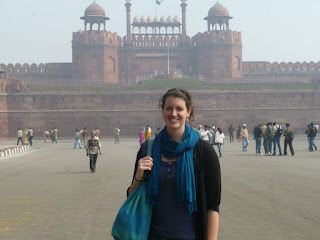
New Delhi was fantastic – there are so so many sights to see. Anu was a trooper and took me to see Qutb Minar, (below) which is one of the first Mughal struc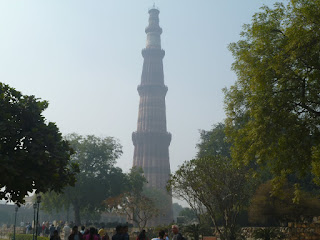 tures in India, built in the 13th century to commemorate the Afghan victory, the Red Fort, (pictured below, also built by Shah Jahan, the Taj Mahal guy Jama Masjid, (India’s largest mosque) Humayun’s Tomb, (recently made famous by Obama’s visit) and even a cute little market area with goods and foods from all over India (vastly different depending on the region.) The next day we hit up some of the more recent structures of the city – the British constructed tons of Neoclassical architectural structures for their official government buildings – today used as embassies, meeting halls, and the President’s House. We also saw India G
 ate, which was built by the British in the 20th ce
 ntury to honor all the Indians who had died fighting overseas in British regiments, Connaught Place, a shopping area where I happily purchased some souvenirs, the National Museum, (we actually only made it to the steps – by that point I was so tired of paying jacked up tourist entrance fees I decided to pass, as we were also tired and running out of time) and even the Baha’i Lotus Temple – very impressive and indeed, lotus shaped. Luckily, New Delhi just recently installed a metro system throughout most of the city, so all of our traveling around was greatly aided by the subway, which interestingly has separate male and female compartments. I loved scoping out all of the beautiful saris, while also noting the contrast between the more modern dress (jeans and t shirts) of the younger generation of girls. Last, Anu took me to one of Asia’s largest shopping malls – I was blown away by how modern it was (actually a series of three malls put together – I only saw one small part of it.) It was fun to be in a shopping mall again.
As interesting and fascinating as all of these sights were to me, one of the things I enjoyed most about Delhi was having a family to stay with, a family who knew the city, knew the country, and were happy to answer my endless questions. As a tourist, it’s easy to just see the bad parts of India: the poverty, the dirtiness, the smells, the tourist hagglers, the noise, while missing out on all of the good parts. India actually has one of the fastest growing economies in the world, and more master’s degrees holders than the entire country of France. The Indian people especially value the importance of education, something many of us Westerners have always taken for granted, and when given the opportunity to access this education, they take it and run with it. I learned a lot about India’s education system from my family and some of their neighbors – it is quite similar to Korea’s actually, with many children going to extra tutoring sessions in subjects like math and science in order to do well in certain entrance exams. I learned that in the majority of schools the subjects are taught in English, as it’s one of India’s national languages, which goes to show how Indians have used their time of oppression by England to their advantage – the combination of being forced to learn English and tendency to excel in math and sciences has led to their extremely successful call center businesses.
Of course, staying with a family meant I received amazing hospitality and was treated with wonderful generosity. I ate so much delicious homemade Indian food and drank many cups of chai tea – a sweet, milky, cinnamon and ginger tea – I was spoiled. Anu taught me a lot about the difference between South Indian food and North Indian food – in the North it is more typical to eat the flat, pancake like bread with curry, while in the South it is primarily eaten with rice. India has twenty eight different states and seven territories, but I now tend to think of India like Europe, with many different small countries stuck together – each state has its own regional food, languages, dialects, customs, and even differences in clothing. It would take many many weeks of traveling, as in Europe, to visit and learn about each state and its traditions!
Delhi was a wonderful learning experience, but of course, I had to move on. My next stop was Jaipur, capital of Rajasthan, the land of kings. Rajasthan is in west India, on the edge of the Thar desert, so the landscape is flat and well, desertlike. I left Delhi early on a morning train to make the five hour journey, where I was to spend the day in Jaipur before departing on a night train that evening to Jodhpur, another Rajasthani city to the south. That suited me just fine, and after storing my huge backpack at the left luggage room in the train station, I set off to explore.
Jaipur is a fairly large city, but after taking an autorickshaw to the Old City, I ended up just hanging out in that area, as it was the most interesting and manageable on foot. The Old City is still surrounded by the old walls, so after entering through the beautiful pink gates, I walked around and observed the sights – tons of little shops lined the roads – not all tourist shops. It actually reminded me of being in an old downtown area in some of the cities in the States – except all the signs were in Hindi a nd there were quite a few more cows hanging out on the road. I entered my first tourist destination after walking around the Old City – the Hawa Mahal, or Women’s Palace, also known as the Palace of the Winds (I learned from my audioguide that it is called the Palace of the Winds due to all of the open holes in the windows and walls to let the air breeze through the palace grounds, for relief from the hot desert sun.) In Rajasthan there was a strict traditional custom called purdah, which basically means segregation – the palace women and royalty had to live separately from the men, and were kept in confinement in the
 palace – special windows were built with screens so that the women were able to look outside at the streets below…but no one could look in and see them. The palace was very pretty inside – the picture by the windows is another example of Rajasthani tradition – due to the desert landscape Rajasthan typically used bright colors such as greens, reds, and blues, for decoration. The outside façade, pictured above, though it is actually the backside of the palace, was impressive as well.
After viewing the palace, I got some help from the audioguide guy, who told me about visiting Amber Fort. I could see one fort from the streets that I planned to visit, but then I found out there was actually a bigger, more impressive fort just beyond the hills, out of view from the city center. I took the local bus (my first in India!) and paid about twenty cents to ride about 5 km north out of the city and up a hill to Amber Fort.
As I stopped for a minute to take in the view, I was asked to be in a picture with two girls - I asked them to return the favor...not realizing that I would end up posing for about ten minutes with other groups of people...and that was just at the entrance. Because it was late afternoon I didn’t have time to see both the palace and the fort, so I elected for the palace – bigger and more impressive than the city center palace, which was used for city municipality – Amber Fort was for defending the entire state of Rajasthan a few hundred years ago, which explained its prime location along the top of the hills. The palace was my favorite in India – beautiful carvings, architecture, gardens, and halls, incl
 uding my perso
 nal favorite, the Mirror Hall. In Indian palaces I noticed that typically everything is open and accessible just by walking up the steps into the open rooms – no doors or closed areas like in European palaces, most likely due to the lack of chilly weather. I especially enjoyed the predominant elephant motif of the Jaipur palace, as elephants used to be a main mode of transportation and preferred animal to take for battle – I’d probably rather have an elephant too if I were heading off to fight…I’d let him do all the work and just stomp on people. There was supposed to be an elephant viewing session or something at the base of the fort, but when I reached the area I found out I missed the viewing time – I was disappointed, as I hadn’t seen any elephants in India yet.
Lo and behold, what do I see tromping down the street as I rode the bus back to the city center not even twenty minutes later? Yes, an elephant, with some dude riding on top of it like it was a Sunday stroll. I was thrilled, and wanted to get up close to take a picture. I hopped off the bus at the next stop – I was maybe 100 yards from the elephant and figured I could catch up.
So now I have to ask, have you ever tried to catch an elephant? Let me warn you for fut ure knowledge: those guys are faster than they look. I stopped to take a quick picture as I entered through a pretty gate into the city walls, and when I looked up I thought, uh oh – how did he get that far so fast? I power walked nearly a mile to catch up to him. However, I was greatly rewarded when I finally did because the guy riding him stopped him for me (it could have been a girl elephant, as he or she was painted with pretty flowers…but I chose to believe it was a boy elephan) and some of the kids on the side of the street – I got to pet him and take some pictures. We bonded instantly. It was a sad goodbye.
After my wild elephant chase it was nearly dinnertime, so I spent the remaining daylight walking back through the old city (luckily the elephant didn’t get me too lost) and heading back to the train station area, where I had a delicious meal, wrote in my journal, and did some reading – the perfect end to a fun and busy day. I had been traveling for about two weeks at that point, and I was looking forward to my next destination, Jodhpur, a small city to the southwest, where I would have two full days to explore yet relax a bit.
 Relax? Me? Yes. That's exactly what I did in Jodhpur. After some hassling by some overfriendly guys at the coffee shop I was hanging out at before my night train in Jaipur, I was really in a nonsocial mood, and didn’t really want to work up the energy to walk throu
 gh the streets and fend off all of the tourist hawkers or answer “what country from you madam?” a million times, so when I arrived in Jodhpur the next morning and saw that it was cloudy, which meant my pictures wouldn’t be as nice, I decided to designate a ‘chill’ day and hope for a cloudless sky the next day. I checked into my hostel, walked around a bit to orient myself, (it was nice and small – no autorickshaws needed) found the city center, and then plopped myself down on the second floor of a cute little coffee shop/restaurant attached to a guest house. I chose the seat by the window so I could at least do some people watching and still get part of the Jodhpur experience, so I would feel a little less guilty. On my way there I also found a great bookstore that I was able to do an exchange with the next day, so I had an extra incentive to read and finish up a couple books that I brought along from Nepal - the more I finished the more new ones I could get! So, I spent the majority of the afternoon reading, writing, and sampling some Indian snacks with my coffee. On my way back to the hostel I detoured a bit and wandered into the old part of the city, where I was rewarded with my first spectacular view of the exact reason I had come to Jodhpur: the houses were painted blue. Yes, blue. And not just any blue - all varieties of bright, beautiful blue. I had read about the famous 'blue city,' when I was researching for my trip, and I knew, though it was pretty far out of the way, that I had to go see this city for myself. More information on this to come, don't you worry.
It turned out that my reasoning regarding the cloud cover was a good decision - the next day was sunny and bright - perfect for heading up to the fort for the afternoon. I spent the morning on the rooftop restaurant of my guesthouse, finishing up my book while enjoying a pot of tea and fresh fruit, then walked the short 20 minutes up to the fort, enjoying the peace and quiet outside of the city. As soon as I walked through the gate I was able to get a much better view of the city below, in all its blue glory. The most accepted theory I read about for why the city is blue is that when people first settled here (Jodhpur is only about six centuries old) the Brahmin priests, the highest caste in the caste system, wanted to have a distinction between their h ouses and the lower castes, so they used indigo to paint their houses, then some time later others followed suit. By the way, the caste system, which is technically not in place anymore but still a traditional mindset for many Hindus, is composed of four social castes that can't intermarry or sometimes can't even associate with others. The highest caste is called Brahmin, the priests, (associated with the head of Brahma, the creator god) then there is the warrior caste, (they came from the heart of Brahma) the merchant caste, (the hands) and finally the artisan caste at the bottom (though sometimes untouchables are included at the bottom - it is such a complex system it's common to hear or read about different explanations. The untouchables are below the artisan caste and were restricted to work in polluting, dirty, or unhealthy jobs, like the bottom of the feet. In Varanasi, I learned that the man responsible for burning the bodies at the cremation ghat is one of the richest men in the city and has a huge house, but as he is an untouchable (since his job deals with dead bodies,) traditionally he has had social limitations.
Anyway, whatever the reason was for the blue city, I'm a fan. Another idea is that the people wanted to use the cool blue color of the houses to simulate the ocean in the middle of the desert - both are valid, but I think I read the Brahmin theory to be the most commonly accepted. Lonely Planet had recommended the free audioguide tour, so I strapped on my headset, got my notebook ready to take notes (yes...I'm one of those people) and set off to explore. Mehrangarh Fort was built in 1459 by Rao Jodha, a Rajput king (Rajput is a state to the south of Rajasthan.) The first thing I learned when I walked inside the fort gates was that the handprints on the wall were actually sati handprints of all of the widows who had last walked through the gate walls. Sati is a custom that wasn't outla wed in India until the 19th century - whe
 n a husband died and was cremated, the widow was required to burn alive with him on the funeral pyre. Slightly disturbing, no? Anyways, inside the fort was the palace museum which had an impressive collection of royal regalia such as elephant saddles, cradles, jewelry, and weapons. The Rajputs were famous for their vicious and fierce fighting skills - after seeing some of their elaborate swords and weapons, I'm not surprised. It was a beautiful afternoon - after the museum I walked along the fort walls, taking in the view of the seemingly endless stretch of little blue houses. It made me so happy. But as always, I had a train to catch much too soon, so I had to say goodbye, pick up my bags, and head to the train station in the early evening for my night train to Mumbai.
I arrived in Mumbai two hours late...(this tends to happen when you take night trains) and there ended up being a miscommunication with the family I was staying with - when I called her for directions she said she would come pick me up, but I told her I would wait at the booking office...turned out I was at the wrong part of the station, and there was a much bigger area just down the tracks that I wasn't aware of, where my host was waiting for me. By the time I called her again we both tried to locate each other, and after about two hours of waiting and searching through the hundreds of people and calling at random pay phones it turned out she had to leave to attend a meeting, and she would have me stay with a friend of hers who lived near the station until she could come pick me up. It wasn't really either of our faults - just bad luck - but it happened to be when I had my heavy bags, I was hot, tired, hadn't eaten all day, and really really needed a shower. All part of the experience!
However, as soon as I walked into her friend Rosie's apartment (about a five minute walk from the station - she sent her son to come pick me up once I finally figured out where I was) my anxieties were relieved as she welcomed me, the very unexpected and probably very smelly houseguest into her home with a big smile, a tray of food, and a hot mug of tea. Rosie's husband, who I actually didn't get to meet, is a pastor, which is how she knew my host Jasmine, whose husband is also a pastor. She and her three boys were great fun - we had a good time chatting and getting to know each other - and after my glorious shower we went out for a walk and delicious dinner in the nearby shopping district. I didn't know too much about Mumbai, but I noticed the difference between the north Indian cities right away due to the many palm trees lining the sidewalks. There was also a hint of sea breeze in the air - I could tell I was going to like Mumbai.
Jasmine and her family ended up getting back from their out of town event quite late, so she and Rosie arranged to have me picked up in the morning, after I was fed a delicious breakfast and, of course, more tea. I had a nice chat with her oldest son, who was beginning junior college - this starts a little before the end of our high school, and it is sort of like taking generals in college - the students take a variety of courses for three years, and then when they attend senior college they focus on just one particular major. He had worked in a call center for a brief time, and I found it extremely interesting t hat during his training, he was taught to 'dumb down' his English to make it easier for American customers to understand. For example, when his mom asked me "so, you are from Minnesota?" he said at work they would be trained to pronounce it like "Minn-uh-so-da," with more of a slur and less annunciation. Try it - say Minnesota like you would normally say it, then with an emphasis on the 't!' I also found out one of the only reasons North American English still has a good reputation, even though it is viewed as more of a 'dirty English' by other countries is because of pop culture and American movies...at least we have that going for us.
The next day I was picked up by Jasmine, and after she finished up some work at the hous e, we walked a short way to Victoria Gardens, now a zoo, and then we went down to the city center to see the port, the Gateway of India, (pictured above) the Taj Hotel, the former Victoria station, (two of the scenes of the recent terrorist bombings in 2008) and all of the other fantastic examples of British architecture - I have to admit they looked slightly out of place surrounded by palm trees, however. The next day we went to the other side of the coast (Mumbai is actually made up of a series of islands, but it is basically like a
 mini peninsula) and saw Chowpatty Beach, walked along the beach boardwalk, and rode the intercity train, which was fun to see the city from. I was fed so much delicious rice and curry that I thought I was going to explode. My hosts were wonderful - I had fun chatting with their two adorable daughters, who were busy studying and going to tuition classes, and Jasmine even taught me how to make chapatis, which are thin, crepe like breads that you eat curry with. Again, I was so lucky to have the opportunity to talk with and learn from them - I also met a friend of hers who was an English and history teacher, so we compared our experiences teaching English. It turns out students are the same all around the world.
I'll spare you some of the history here, as I'm sure you're eyes are bugging out if you've read this far. If you think you can make it three more paragraphs, I'll finish up my India experience with my final destination, Goa.
Goa was, in a word, awesome. I was really really looking forward to it, and I felt that by leaving it until the end I would really deserve to have a beach day to end my India trip with - I was correct. I also realized w hen I got there that it was good I didn't start there and plan to go north, because otherwise I probably wouldn't have left. After my night bus to Goa (I much much prefer trains, I decided) I had to catch a couple other buses to get to the southern part of Goa (which is a state, not just a city name,) where there was a small, beautiful beach with my name on it. The trip down there, however, was one of the most scenic trips in India, as the landscape was bright, fresh green populated with thousands of coconut palm trees - absolutely beautiful.
I arrived in Palolem, a tiny one street 'town,' and with the help of a woman who had been staying there for the past five months (again, I had really good luck asking fellow foreigners for directions) I found a cheap and reasonable guesthouse just a couple of minutes from the beach. I dropped my stuff, changed my clothes, and nearly bolted through the tr ees to catch the last few hours of afternoon sunshine - and then I saw the beach. My jaw almost dropped - it was perfect. Crescent shaped, palm trees lining the sand, white sand, little beach hut restaurants and shacks all along the edge, and beautiful sparkling blue water. It was all there - I was so happy! I began by staking out a spot on the beach - there were quite a few foreigners there, but with Goa's recent fame in the past few decades this didn't surprise me - and taking a nap in the sun. The beach was the perfect reward after nearly three weeks on the road. After my little beach nap I went back to my room to take a quick shower, the
 n I walked down the beach perusing menus in search of the perfect beach dinner: seafood curry. I wasn't disappointed - it was probably the best meal of India - and I ate it watching the sunset over the beach, listening to the waves, (all the restaurants were open air - you just walk right up to them in the sand and sit yourself down) and smelling the ocean breeze.
I spent the majority of my last day in India on the beach: I woke up early for a sunrise beach walk, which was lovely, and then after fresh fruit, fruit juice, and a coconut pancake (a spicy coconut pancake! Goan specialty) for breakfast I set out to finish my last India book: The Mahabarata, kind of like the Iliad of Indian culture - about an epic war between two clans, with gods intervening and random stories here and there meant to illustrate good behavior and how people should live their lives. They say you can't understand India until you've read the Mahabarata and the Ramayana, so I read them both on my trip - I learned a lot about the Hindu pantheon of gods and their roles in mortal lives, as well as learned about the importance that is stressed on karma, good behavior, the Hindu life cycle of being reborn into different lives, and especially Dharma, which is kind of the underlying yin and yang-like philosophy of how life should be lived, in accordance with good character and morality. It was really interesting - I had to take notes to keep all the names and terms straight - and I was determined to finish it while still in India, so I spent the morning and early afternoon reading on the beach, with little naps and even a swim in between reading. After I was thoroughly toasted and finished the book, I stopped at a little bookstall on the way back to my guesthouse and successfully traded a few more books for the rest of my trip. I had a morning flight out of Bangalore the next day (the cheapest place to fly to Sri Lanka,) so sadly I had to say goodbye to Goa that evening and hit up my last night bus of the trip to get me to Bangalore by 7 AM - I was terribly nervous the bus would be late or something would happen so I would miss the plane, but I lucked out and made it to the airport by 8 AM. I said my goodbyes to India quickly from the airplane, as I passed out even before we took off. I was proud of myself for making it through the past three weeks - it had been a pretty demanding trip, but I don't think I would have liked to do it any other way - I kept saying a short time in one place is better than no time at all. As the plane took me south to the tiny little teardrop shaped island, my next destination, I turned my thoughts to what lay before me: my next to last stop, Sri Lanka.
 rt of Varanasi is centered on the western banks of the Ganges, where there are dozens of ghats, or steps, leading into the water. Varanasi is also the most auspicious place to die, so when Hindus pass away, ideally their families will take them to Varanasi to be cremated on the riverbanks, and the ash thrown in the water for good luck in their next life. My hostel was near the cremation ghat, and when we were out walking around in the streets we were passed by about five funeral processions, with four men carrying wrapped dead bodies on little cot like things on their shoulders while chanting on their way down to the riverbank.
 The next morning I was up bright and early for my boat trip, with three other guests. Our boat guy doubled as a guide, so he taught us quite a bit about Varanasi and its importance for Hindus, as well as explained what it was we were seeing in front of us. Even at 5 AM in the da
 rkness there were people on the ghats bathing, praying, and giving offerings – either setting little floating candles or flowers in the water. The boat trip was awesome – I had never seen anything like it. Luckily, I happened to be there on a festival day, so the ghats were packed with people of all ages dressed in their bright clothing, dunking themselves up and down in the river, eating, and praying. After the boat trip I walked around with another hostel guest, and tried to absorb the sights, sounds, and colors – it was so interesting to see how powerful the Hindu faith and religion was to the hundreds of people who made the trip that day, and to think about the millions of Hindus who have been making the trip for the past two thousand years. I spent a wonderful morning walking a
 round and observing, tak
 ing pictures, and getting introduced to India – it was even better than I imagined, once you sidestepped (quite literally) all the cows in the street, the pollution, the noise, the beggars, and the poverty. Again, you have to take the good with the bad. The old streets of Varanasi, the ones too narrow for cars, right along the ghats, were fascinating to walk around as well.
 Next stop: Agra. Home to the famous Taj Mahal, built in 1632 by the Mughal emperor Shah Jahan. The Taj Mahal is actually a tomb, built for his wife Mumtaz after she died in childbirth, so the legend goes. I was due in Delhi that evening, so I had most of the day to spend in Agra after arriving from Varanasi on my first night train. I had a bit of a cold from Nepal, and though I was able to sleep on the train it wasn't what you would call a sound sleep, so I wasn’t feeling the greatest. Of course, I wasn’t going to let that stop me. When I got off the train I ran into a Lithuanian couple that I had been chatting to at the train station – I ended up spending most of the day with them, since we shared a taxi ride to the Taj Mahal from the train station and then made plans to meet up for lunch later.
What can I say about the Taj Mahal? It was magnificent – the pictures honestly don’t do it justice. I couldn’t stop staring – to actually see it in person was unbelievable. It is located on top of a high platform, for which you have to remove your shoes or wear shoe covers before stepping on, if you want to go up close or inside the Taj Mahal. After paying the 15 dollar foreigner fee (locals pay about 40
 cents) we were led through security, and then entered through the West Gate. We arrived nice and early, just after sunrise, so it was still relatively quiet and not too busy, though we all waited here and there for people to get out of the way for pictures – at least everyone understands the importance of having a really good picture in front of the Taj Mahal, even if it takes a couple of tries on the digital. Unfortunately, I was on my third day of not showering due to my hostel’s questionable bathroom and the night train – please forgive my pictures...
We (the Lithuanians and I) actually had a guide with us for the first hour or so, since after refusing about ten times he dropped his price for us by about four times and we figured having him around would fend off other hopeful guides (plus there were three of us – I think we paid him the equivalent of four dollars total.) He walked us in through the gardens, taking pictures for us and explaining a bit about the history and architecture. Fun facts time: 1. The tombs are false, and the bodies are actually kept in a vault underneath the building. 2. The Taj Mahal is identical on all four sides, with the backside facing the Yamuna River. Of course, the front is the most impressive as the gardens, reflecting pond, and walkways are all in front of it. 3. There was originally one mosque built to the west of the Taj Mahal, and Shah Jahan ended up building another identical building to the east for symmetry’s sake. After our guide left us in peace, we split up and I was on my own, free to wander at will before meeting up later for lunch with the Lithuanians.
One of my favorite parts of the Taj visit was getting up close to look at the beautiful inlays of semiprecious stones in the white marble – n
 othing is painted, it is all done by hand carving and inlay technique – absolutely beautiful. The Arabic script is also inlay work, with quotes from the Koran, the holy book of Islam, inscribed on the walls. (The Koran inscriptions are to the far left of the flower inlay picture.) I walked all around the outside, the inside, the mosques (my first mosque) and the gardens, enjoying the view from all angles. We did some photo shoots out in the gardens, and then I spent some time just sitting on a bench watching everyone take pictures. It was great because just about every kind of person was there – the rich and fabulous, the classic American tourists with fanny packs and tennis shoes (the southern accent was a dead giveaway too), the cute elderly couples, the
  families with kids, the hordes of European and Asian tourist groups that looked like their necks were about to break from their heavy cameras, and the Indian tourists. However, it was busy with all of the people, so I went back up to the platform to sit in a quieter location while I waited to meet up for lunch and ended up finding a secluded bench behind the Taj Mahal looking over the river. The sun was nice and hot, I was tired, my cold was kicking in, and my marble bench was so inviting that I ended up laying back and taking a nap for about 15 minutes. What a sight to wake up to.
After lunch we walked the short distance down the river to Agra Fort, the emperor’s old palace. Agra was actually the capital of the Mughal Empire a few hundred years ago, in between Delhi – I wished I had had some more time to explore some more of the earlier architecture. Next time. Anyway, Agra Fort was a wonderful leisurely location – huge, green, very impressive grounds, not too many tourists, and fun to explore. An interesting story about Agra Fort is that in 1659, Emperor Shah Jahan's son Aurangzeb ended
 up revolting against his father for control of the e
 mpire – Shah Jahan barricaded the fort from his son and his army – he held Aurangzeb off for three days, but his son had sneakily cut off the water supply to the fort, so Shah Jahan was forced to surrender. As a result, Aurangzeb imprisoned him in Agra Fort, where he remained for the last six years of his life. Rumor has it that he died in one of the tower balconies that overlooks the Yamuna River and the view of the Taj, where he longed to join his beloved wife for six long years. Poor guy!
Agra was a short but necessary stop – my next destination was to India's capital city, New Delhi. I took a short three hour train to the capital city, where I was greeted by my host for three days, Immanuel. Immanuel is cousins with a friend of my mom’s back home, who I am still so grateful to for helping me out on my India plans. He drove me back to the apartment to meet his family and settle in – I was pretty tired out. After meeting his family (his wife Anu, daughter Tabitha - 15, and son Silas - 8) I was fed a delicious curry meal, while we discussed the next day’s plans. Anu was kind enough to take the day off of work to be my unofficial tour guide. I went to bed exhausted, but well fed, clean, and excited to explore New Delhi the following day.
New Delhi was fantastic – there are so so many sights to see. Anu was a trooper and took me to see Qutb Minar, (below) which is one of the first Mughal struc
 tures in India, built in the 13th century to commemorate the Afghan victory, the Red Fort, (pictured below, also built by Shah Jahan, the Taj Mahal guy Jama Masjid, (India’s largest mosque) Humayun’s Tomb, (recently made famous by Obama’s visit) and even a cute little market area with goods and foods from all over India (vastly different depending on the region.) The next day we hit up some of the more recent structures of the city – the British constructed tons of Neoclassical architectural structures for their official government buildings – today used as embassies, meeting halls, and the President’s House. We also saw India G
 ate, which was built by the British in the 20th ce
 ntury to honor all the Indians who had died fighting overseas in British regiments, Connaught Place, a shopping area where I happily purchased some souvenirs, the National Museum, (we actually only made it to the steps – by that point I was so tired of paying jacked up tourist entrance fees I decided to pass, as we were also tired and running out of time) and even the Baha’i Lotus Temple – very impressive and indeed, lotus shaped. Luckily, New Delhi just recently installed a metro system throughout most of the city, so all of our traveling around was greatly aided by the subway, which interestingly has separate male and female compartments. I loved scoping out all of the beautiful saris, while also noting the contrast between the more modern dress (jeans and t shirts) of the younger generation of girls. Last, Anu took me to one of Asia’s largest shopping malls – I was blown away by how modern it was (actually a series of three malls put together – I only saw one small part of it.) It was fun to be in a shopping mall again.
As interesting and fascinating as all of these sights were to me, one of the things I enjoyed most about Delhi was having a family to stay with, a family who knew the city, knew the country, and were happy to answer my endless questions. As a tourist, it’s easy to just see the bad parts of India: the poverty, the dirtiness, the smells, the tourist hagglers, the noise, while missing out on all of the good parts. India actually has one of the fastest growing economies in the world, and more master’s degrees holders than the entire country of France. The Indian people especially value the importance of education, something many of us Westerners have always taken for granted, and when given the opportunity to access this education, they take it and run with it. I learned a lot about India’s education system from my family and some of their neighbors – it is quite similar to Korea’s actually, with many children going to extra tutoring sessions in subjects like math and science in order to do well in certain entrance exams. I learned that in the majority of schools the subjects are taught in English, as it’s one of India’s national languages, which goes to show how Indians have used their time of oppression by England to their advantage – the combination of being forced to learn English and tendency to excel in math and sciences has led to their extremely successful call center businesses.
Of course, staying with a family meant I received amazing hospitality and was treated with wonderful generosity. I ate so much delicious homemade Indian food and drank many cups of chai tea – a sweet, milky, cinnamon and ginger tea – I was spoiled. Anu taught me a lot about the difference between South Indian food and North Indian food – in the North it is more typical to eat the flat, pancake like bread with curry, while in the South it is primarily eaten with rice. India has twenty eight different states and seven territories, but I now tend to think of India like Europe, with many different small countries stuck together – each state has its own regional food, languages, dialects, customs, and even differences in clothing. It would take many many weeks of traveling, as in Europe, to visit and learn about each state and its traditions!
Delhi was a wonderful learning experience, but of course, I had to move on. My next stop was Jaipur, capital of Rajasthan, the land of kings. Rajasthan is in west India, on the edge of the Thar desert, so the landscape is flat and well, desertlike. I left Delhi early on a morning train to make the five hour journey, where I was to spend the day in Jaipur before departing on a night train that evening to Jodhpur, another Rajasthani city to the south. That suited me just fine, and after storing my huge backpack at the left luggage room in the train station, I set off to explore.
Jaipur is a fairly large city, but after taking an autorickshaw to the Old City, I ended up just hanging out in that area, as it was the most interesting and manageable on foot. The Old City is still surrounded by the old walls, so after entering through the beautiful pink gates, I walked around and observed the sights – tons of little shops lined the roads – not all tourist shops. It actually reminded me of being in an old downtown area in some of the cities in the States – except all the signs were in Hindi a
 nd there were quite a few more cows hanging out on the road. I entered my first tourist destination after walking around the Old City – the Hawa Mahal, or Women’s Palace, also known as the Palace of the Winds (I learned from my audioguide that it is called the Palace of the Winds due to all of the open holes in the windows and walls to let the air breeze through the palace grounds, for relief from the hot desert sun.) In Rajasthan there was a strict traditional custom called purdah, which basically means segregation – the palace women and royalty had to live separately from the men, and were kept in confinement in the
 palace – special windows were built with screens so that the women were able to look outside at the streets below…but no one could look in and see them. The palace was very pretty inside – the picture by the windows is another example of Rajasthani tradition – due to the desert landscape Rajasthan typically used bright colors such as greens, reds, and blues, for decoration. The outside façade, pictured above, though it is actually the backside of the palace, was impressive as well.
 After viewing the palace, I got some help from the audioguide guy, who told me about visiting Amber Fort. I could see one fort from the streets that I planned to visit, but then I found out there was actually a bigger, more impressive fort just beyond the hills, out of view from the city center. I took the local bus (my first in India!) and paid about twenty cents to
 ride about 5 km north out of the city and up a hill to Amber Fort.
As I stopped for a minute to
 take in the view, I was asked to be in a picture with two girls - I asked them to return the favor...not realizing that I would end up posing for about ten minutes with other groups of people...and that was just at the entrance. Because it was late afternoon I didn’t have time to see both the palace and the fort, so I elected for the palace – bigger and more impressive than the city center palace, which was used for city municipality – Amber Fort was for defending the entire state of Rajasthan a few hundred years ago, which explained its prime location along the top of the hills. The palace was my favorite in India – beautiful carvings, architecture, gardens, and halls, incl
 uding my perso
 nal favorite, the Mirror Hall. In Indian palaces I noticed that typically everything is open and accessible just by walking up the steps into the open rooms – no doors or closed areas like in European palaces, most likely due to the lack of chilly weather. I especially enjoyed the predominant elephant motif of the Jaipur palace, as elephants used to be a main mode of transportation and preferred animal to take for battle – I’d probably rather have an elephant too if I were heading off to fight…I’d let him do all the work and just stomp on people. There was supposed to be an elephant viewing session or something at the base of the fort, but when I reached the area I found out I missed the viewing time – I was disappointed, as I hadn’t seen any elephants in India yet.
Lo and behold, what do I see tromping down the street as I rode the bus back to the city center not even twenty minutes later? Yes, an elephant, with some dude riding on top of it like it was a Sunday stroll. I was thrilled, and wanted to get up close to take a picture. I hopped off the bus at the next stop – I was maybe 100 yards from the elephant and figured I could catch up.
So now I have to ask, have you ever tried to catch an elephant? Let me warn you for fut
 ure knowledge: those guys are faster than they look. I stopped to take a quick picture as I entered through a pretty gate into the city walls, and when I looked up I thought, uh oh – how did he get that far so fast? I power walked nearly a mile to catch up to him. However, I was greatly rewarded when I finally did because the guy riding him stopped him for me (it could have been a girl elephant, as he or she was painted with pretty flowers…but I chose to believe it was a boy elephan) and some of the kids on the side of the street – I got to pet him and take some pictures. We bonded instantly. It was a sad goodbye.
 After my wild elephant chase it was nearly dinnertime, so I spent the remaining daylight walking back through the old city (luckily the elephant didn’t get me too lost) and heading back to the train station area, where I had a delicious meal, wrote in my journal, and did some reading – the perfect end to a fun and busy day. I had been traveling for about two weeks at that point, and I was looking forward to my next destination, Jodhpur, a small city to the southwest, where I would have two full days to explore yet relax a bit.
 Relax? Me? Yes. That's exactly what I did in Jodhpur. After some hassling by some overfriendly guys at the coffee shop I was hanging out at before my night train in Jaipur, I was really in a nonsocial mood, and didn’t really want to work up the energy to walk throu
 gh the streets and fend off all of the tourist hawkers or answer “what country from you madam?” a million times, so when I arrived in Jodhpur the next morning and saw that it was cloudy, which meant my pictures wouldn’t be as nice, I decided to designate a ‘chill’ day and hope for a cloudless sky the next day. I checked into my hostel, walked around a bit to orient myself, (it was nice and small – no autorickshaws needed) found the city center, and then plopped myself down on the second floor of a cute little coffee shop/restaurant attached to a guest house. I chose the seat by the window so I could at least do some people watching and still get part of the Jodhpur experience, so I would feel a little less guilty. On my way there I also found a great bookstore that I was able to do an exchange with the next day, so I had an extra incentive to read and finish up a couple books that I brought along from Nepal - the more I finished the more new ones I could get! So, I spent the majority of the afternoon reading, writing, and sampling some Indian snacks with my coffee. On my way back to the hostel I detoured a bit and wandered into the old part of the city, where I was rewarded with my first spectacular view of the exact reason I had come to Jodhpur: the houses were painted blue. Yes, blue. And not just any blue - all varieties of bright, beautiful blue. I had read about the famous 'blue city,' when I was researching for my trip, and I knew, though it was pretty far out of the way, that I had to go see this city for myself. More information on this to come, don't you worry.
 It turned out that my reasoning regarding the cloud cover was a good decision - the next day was sunny and bright - perfect for heading up to the fort for the afternoon. I spent the morning on the rooftop restaurant of my guesthouse, finishing up my book while enjoying a pot of tea and fresh fruit, then walked the short 20 minutes up to the fort, enjoying the peace and quiet outside of the city. As soon as I walked through the gate I was able to get a much better view of the city below, in all its blue glory. The most accepted theory I read about for why the city is blue is that when people first settled here (Jodhpur is only about six centuries old) the Brahmin priests, the highest caste in the caste system, wanted to have a distinction between their h
 ouses and the lower castes, so they used indigo to paint their houses, then some time later others followed suit. By the way, the caste system, which is technically not in place anymore but still a traditional mindset for many Hindus, is composed of four social castes that can't intermarry or sometimes can't even associate with others. The highest caste is called Brahmin, the priests, (associated with the head of Brahma, the creator god) then there is the warrior caste, (they came from the heart of Brahma) the merchant caste, (the hands) and finally the artisan caste at the bottom (though sometimes untouchables are included at the bottom - it is such a complex system it's common to hear or read about different explanations. The untouchables are below the artisan caste and were restricted to work in polluting, dirty, or unhealthy jobs, like the bottom of the feet. In Varanasi, I learned that the man responsible for burning the bodies at the cremation ghat is one of the richest men in the city and has a huge house, but as he is an untouchable (since his job deals with dead bodies,) traditionally he has had social limitations.
 Anyway, whatever the reason was for the blue city, I'm a fan. Another idea is that the people wanted to use the cool blue color of the houses to simulate the ocean in the middle of the desert - both are valid, but I think I read the Brahmin theory to be the most commonly accepted. Lonely Planet had recommended the free audioguide tour, so I strapped on my headset, got my notebook ready to take notes (yes...I'm one of those people) and set off to explore. Mehrangarh Fort was built in 1459 by Rao Jodha, a Rajput king (Rajput is a state to the south of Rajasthan.) The first thing I learned when I walked inside the fort gates was that the handprints on the wall were actually sati handprints of all of the widows who had last walked through the gate walls. Sati is a custom that wasn't outla
 wed in India until the 19th century - whe
 n a husband died and was cremated, the widow was required to burn alive with him on the funeral pyre. Slightly disturbing, no? Anyways, inside the fort was the palace museum which had an impressive collection of royal regalia such as elephant saddles, cradles, jewelry, and weapons. The Rajputs were famous for their vicious and fierce fighting skills - after seeing some of their elaborate swords and weapons, I'm not surprised. It was a beautiful afternoon - after the museum I walked along the fort walls, taking in the view of the seemingly endless stretch of little blue houses. It made me so happy. But as always, I had a train to catch much too soon, so I had to say goodbye, pick up my bags, and head to the train station in the early evening for my night train to Mumbai.
I arrived in Mumbai two hours late...(this tends to happen when you take night trains) and there ended up being a miscommunication with the family I was staying with - when I called her for directions she said she would come pick me up, but I told her I would wait at the booking office...turned out I was at the wrong part of the station, and there was a much bigger area just down the tracks that I wasn't aware of, where my host was waiting for me. By the time I called her again we both tried to locate each other, and after about two hours of waiting and searching through the hundreds of people and calling at random pay phones it turned out she had to leave to attend a meeting, and she would have me stay with a friend of hers who lived near the station until she could come pick me up. It wasn't really either of our faults - just bad luck - but it happened to be when I had my heavy bags, I was hot, tired, hadn't eaten all day, and really really needed a shower. All part of the experience!
However, as soon as I walked into her friend Rosie's apartment (about a five minute walk from the station - she sent her son to come pick me up once I finally figured out where I was) my anxieties were relieved as she welcomed me, the very unexpected and probably very smelly houseguest into her home with a big smile, a tray of food, and a hot mug of tea. Rosie's husband, who I actually didn't get to meet, is a pastor, which is how she knew my host Jasmine, whose husband is also a pastor. She and her three boys were great fun - we had a good time chatting and getting to know each other - and after my glorious shower we went out for a walk and delicious dinner in the nearby shopping district. I didn't know too much about Mumbai, but I noticed the difference between the north Indian cities right away due to the many palm trees lining the sidewalks. There was also a hint of sea breeze in the air - I could tell I was going to like Mumbai.
Jasmine and her family ended up getting back from their out of town event quite late, so she and Rosie arranged to have me picked up in the morning, after I was fed a delicious breakfast and, of course, more tea. I had a nice chat with her oldest son, who was beginning junior college - this starts a little before the end of our high school, and it is sort of like taking generals in college - the students take a variety of courses for three years, and then when they attend senior college they focus on just one particular major. He had worked in a call center for a brief time, and I found it extremely interesting t
 hat during his training, he was taught to 'dumb down' his English to make it easier for American customers to understand. For example, when his mom asked me "so, you are from Minnesota?" he said at work they would be trained to pronounce it like "Minn-uh-so-da," with more of a slur and less annunciation. Try it - say Minnesota like you would normally say it, then with an emphasis on the 't!' I also found out one of the only reasons North American English still has a good reputation, even though it is viewed as more of a 'dirty English' by other countries is because of pop culture and American movies...at least we have that going for us.
The next day I was picked up by Jasmine, and after she finished up some work at the hous
 e, we walked a short way to Victoria Gardens, now a zoo, and then we went down to the city center to see the port, the Gateway of India, (pictured above) the Taj Hotel, the former Victoria station, (two of the scenes of the recent terrorist bombings in 2008) and all of the other fantastic examples of British architecture - I have to admit they looked slightly out of place surrounded by palm trees, however. The next day we went to the other side of the coast (Mumbai is actually made up of a series of islands, but it is basically like a
 mini peninsula) and saw Chowpatty Beach, walked along the beach boardwalk, and rode the intercity train, which was fun to see the city from. I was fed so much delicious rice and curry that I thought I was going to explode. My hosts were wonderful - I had fun chatting with their two adorable daughters, who were busy studying and going to tuition classes, and Jasmine even taught me how to make chapatis, which are thin, crepe like breads that you eat curry with. Again, I was so lucky to have the opportunity to talk with and learn from them - I also met a friend of hers who was an English and history teacher, so we compared our experiences teaching English. It turns out students are the same all around the world.
I'll spare you some of the history here, as I'm sure you're eyes are bugging out if you've read this far. If you think you can make it three more paragraphs, I'll finish up my India experience with my final destination, Goa.
Goa was, in a word, awesome. I was really really looking forward to it, and I felt that by leaving it until the end I would really deserve to have a beach day to end my India trip with - I was correct. I also realized w
 hen I got there that it was good I didn't start there and plan to go north, because otherwise I probably wouldn't have left. After my night bus to Goa (I much much prefer trains, I decided) I had to catch a couple other buses to get to the southern part of Goa (which is a state, not just a city name,) where there was a small, beautiful beach with my name on it. The trip down there, however, was one of the most scenic trips in India, as the landscape was bright, fresh green populated with thousands of coconut palm trees - absolutely beautiful.
 I arrived in Palolem, a tiny one street 'town,' and with the help of a woman who had been staying there for the past five months (again, I had really good luck asking fellow foreigners for directions) I found a cheap and reasonable guesthouse just a couple of minutes from the beach. I dropped my stuff, changed my clothes, and nearly bolted through the tr
 ees to catch the last few hours of afternoon sunshine - and then I saw the beach. My jaw almost dropped - it was perfect. Crescent shaped, palm trees lining the sand, white sand, little beach hut restaurants and shacks all along the edge, and beautiful sparkling blue water. It was all there - I was so happy! I began by staking out a spot on the beach - there were quite a few foreigners there, but with Goa's recent fame in the past few decades this didn't surprise me - and taking a nap in the sun. The beach was the perfect reward after nearly three weeks on the road. After my little beach nap I went back to my room to take a quick shower, the
 n I walked down the beach perusing menus in search of the perfect beach dinner: seafood curry. I wasn't disappointed - it was probably the best meal of India - and I ate it watching the sunset over the beach, listening to the waves, (all the restaurants were open air - you just walk right up to them in the sand and sit yourself down) and smelling the ocean breeze.
I spent the majority of my last day in India on the beach: I woke
 up early for a sunrise beach walk, which was lovely, and then after fresh fruit, fruit juice, and a coconut pancake (a spicy coconut pancake! Goan specialty) for breakfast I set out to finish my last India book: The Mahabarata, kind of like the Iliad of Indian culture - about an epic war between two clans, with gods intervening and random stories here and there meant to illustrate good behavior and how people should live their lives. They say you can't understand India until you've read the Mahabarata and the Ramayana, so I read them both on my trip - I learned a lot about the Hindu pantheon of gods and their roles in mortal lives, as well as learned about the importance that is stressed on karma, good behavior, the Hindu life cycle of being reborn into different lives, and especially Dharma, which is kind of the underlying yin and yang-like philosophy of how life should be lived, in accordance with good character and morality. It was really interesting - I had to take notes to keep all the names and terms straight - and I was determined to finish it while still in India, so I spent the morning and early afternoon reading on the beach, with little naps and even a swim in between reading. After I was thoroughly toasted and finished the book, I stopped at a little bookstall on the way back to my guesthouse and successfully traded a few more books for the rest of my trip. I had a morning flight out of Bangalore the next day (the cheapest place to fly to Sri Lanka,) so sadly I had to say goodbye to Goa that evening and hit up my last night bus of the trip to get me to Bangalore by 7 AM - I was terribly nervous the bus would be late or something would happen so I would miss the plane, but I lucked out and made it to the airport by 8 AM. I said my goodbyes to India quickly from the airplane, as I passed out even before we took off. I was proud of myself for making it through the past three weeks - it had been a pretty demanding trip, but I don't think I would have liked to do it any other way - I kept saying a short time in one place is better than no time at all. As the plane took me south to the tiny little teardrop shaped island, my next destination, I turned my thoughts to what lay before me: my next to last stop, Sri Lanka.


